- The short version
- House prices in Portugal: homes cost more
- Pay in Portugal: wages did not keep up
- Mortgages in Portugal: so buyers borrow more
- Who is buying homes in Portugal
- Where house prices rose most
- How many homes are selling
- Are house prices in Portugal too high?
- If you are buying a home in Portugal
- If you are selling a home in Portugal
- How to read these figures
- How to cite this report
- Sources
Share this report. Each highlighted fact has its own link, an image ready for Instagram, TikTok or video, and a snippet for blogs. They all lead back here and name the original source.
The short version
Homes in Portugal cost more. Prices rose 17.6% in 2025, the biggest yearly rise since INE started its index in 2009, and were still rising 16.5% a year in mid 2026.
Pay did not keep up. It rose 5.6% in 2025 and 5.1% in the first half of 2026. The same home that cost 5.4 years of average pay in 2015 cost 8.4 years in 2024 and is heading for about 10 in 2026.
So buyers borrow more. The average new mortgage grew 21.1% in 2025, to €175,141, and banks now fund over half of what is spent on homes, the most since 2011.
The figures come from INE, Banco de Portugal and Eurostat. If you are buying or selling this year, these are the numbers behind every price you will be quoted.
House prices in Portugal: homes cost more
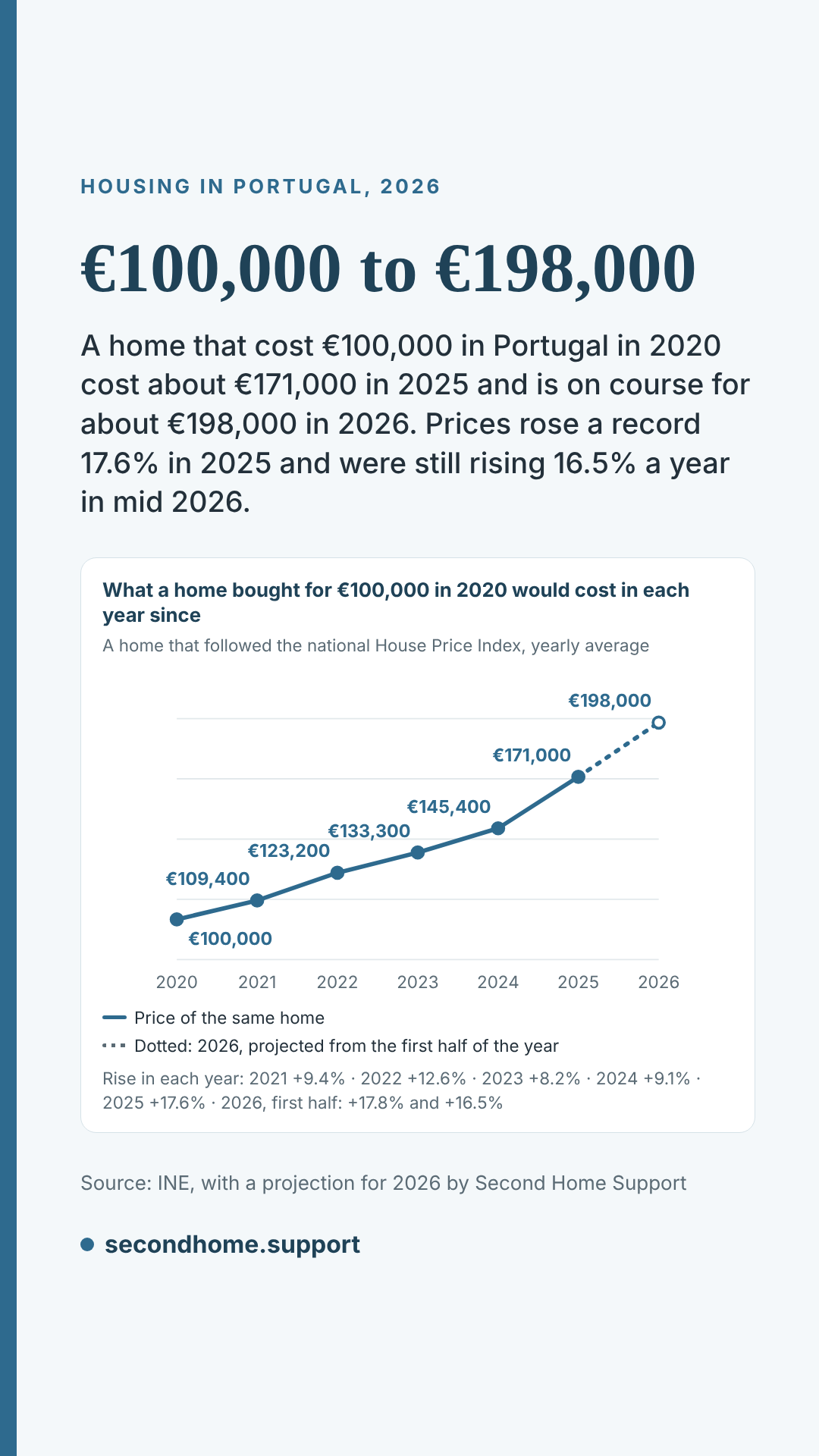
A home that cost €100,000 in Portugal in 2020 cost about €171,000 in 2025 and is on course for about €198,000 in 2026. Prices rose a record 17.6% in 2025 and were still rising 16.5% a year in mid 2026.
What a home bought for €100,000 in 2020 would cost in each year since
A home that followed the national House Price Index, yearly average
Rise in each year: 2021 +9.4% · 2022 +12.6% · 2023 +8.2% · 2024 +9.1% · 2025 +17.6% · 2026, first half: +17.8% and +16.5%
Source: INE, with a projection for 2026 by Second Home SupportData to: June 2026 · Next update: December 2026
secondhome.support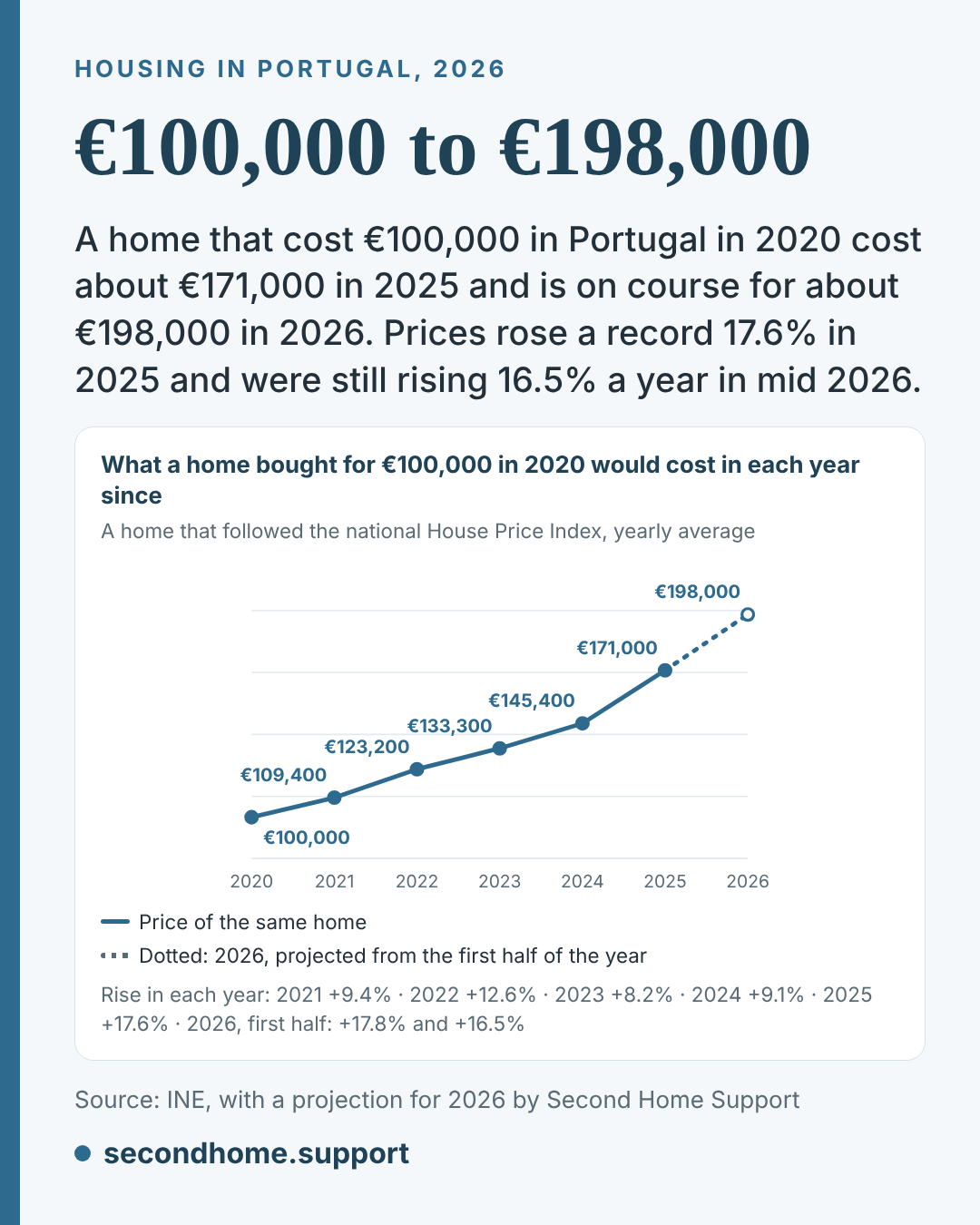
Each year's rise sits on top of the last
Take a home bought for €100,000 in 2020 and move it with the national index: about €109,400 in 2021, €123,200 in 2022, €133,300 in 2023, €145,400 in 2024 and €171,000 in 2025. That is 71% in five years, and about €198,000 on our projection for 2026. Each year's rise is counted on top of the last, which is why five rises that add up to 57 points come to 71%.
The index follows the same kind of home
INE's House Price Index follows the price of the same kind of home over time, so a year with more expensive homes on the market does not distort it. In 2025, homes that had been lived in before rose 18.9% and new homes rose 14.2%.
Since then, by quarter
Change against the same quarter a year earlier
Source: INE, House Price Index, quarterly releases.
secondhome.supportThe rise has slowed a little in 2026
Prices rose 17.8% in the first quarter and 16.5% in the second, each against the same quarter a year before. In 2025 the four quarters ran from 16.3% to 18.9%.
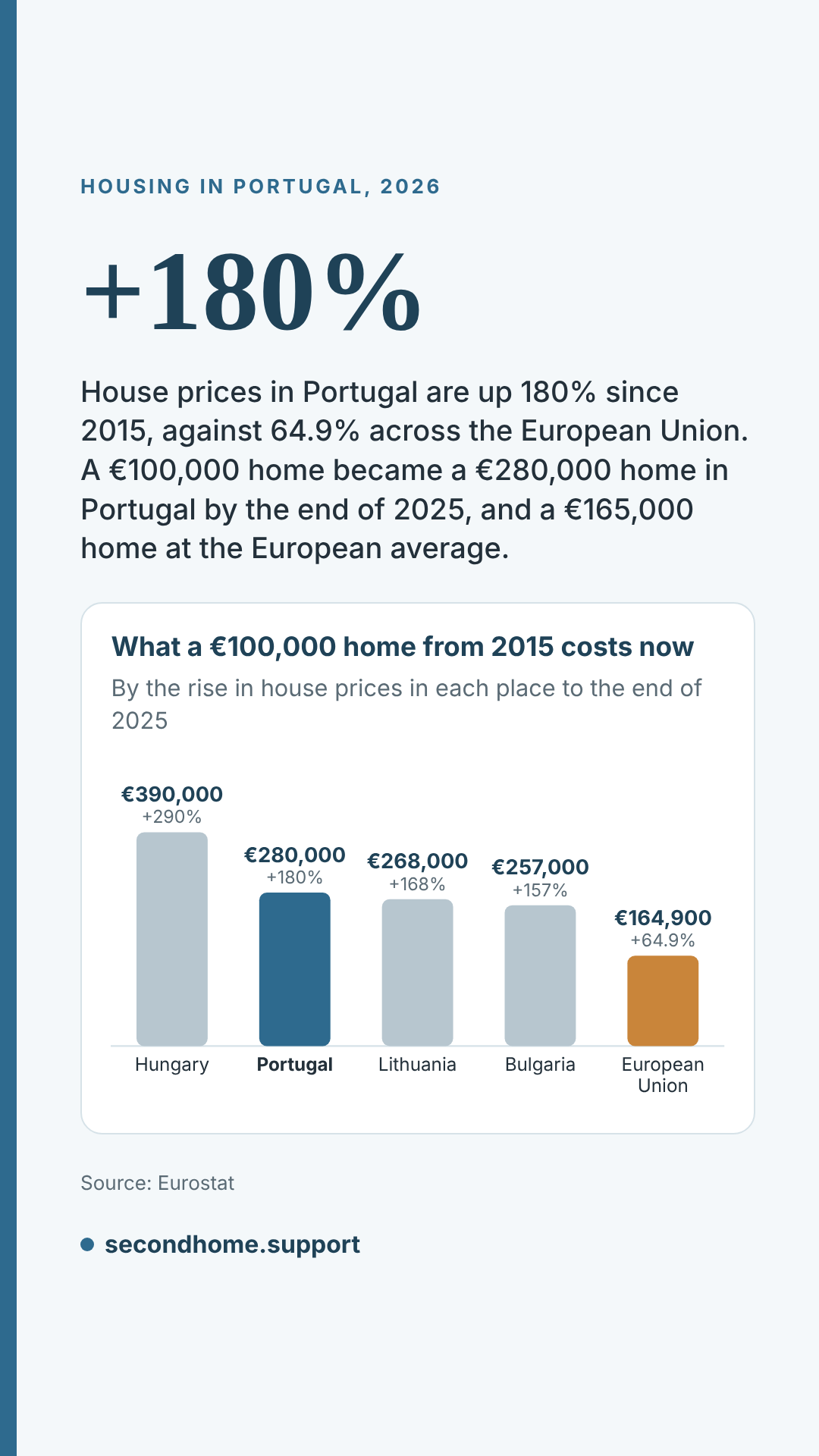
House prices in Portugal are up 180% since 2015, against 64.9% across the European Union. A €100,000 home became a €280,000 home in Portugal by the end of 2025, and a €165,000 home at the European average.
What a €100,000 home from 2015 costs now
By the rise in house prices in each place to the end of 2025
Source: EurostatData to: December 2025 · Next update: Early 2027
secondhome.support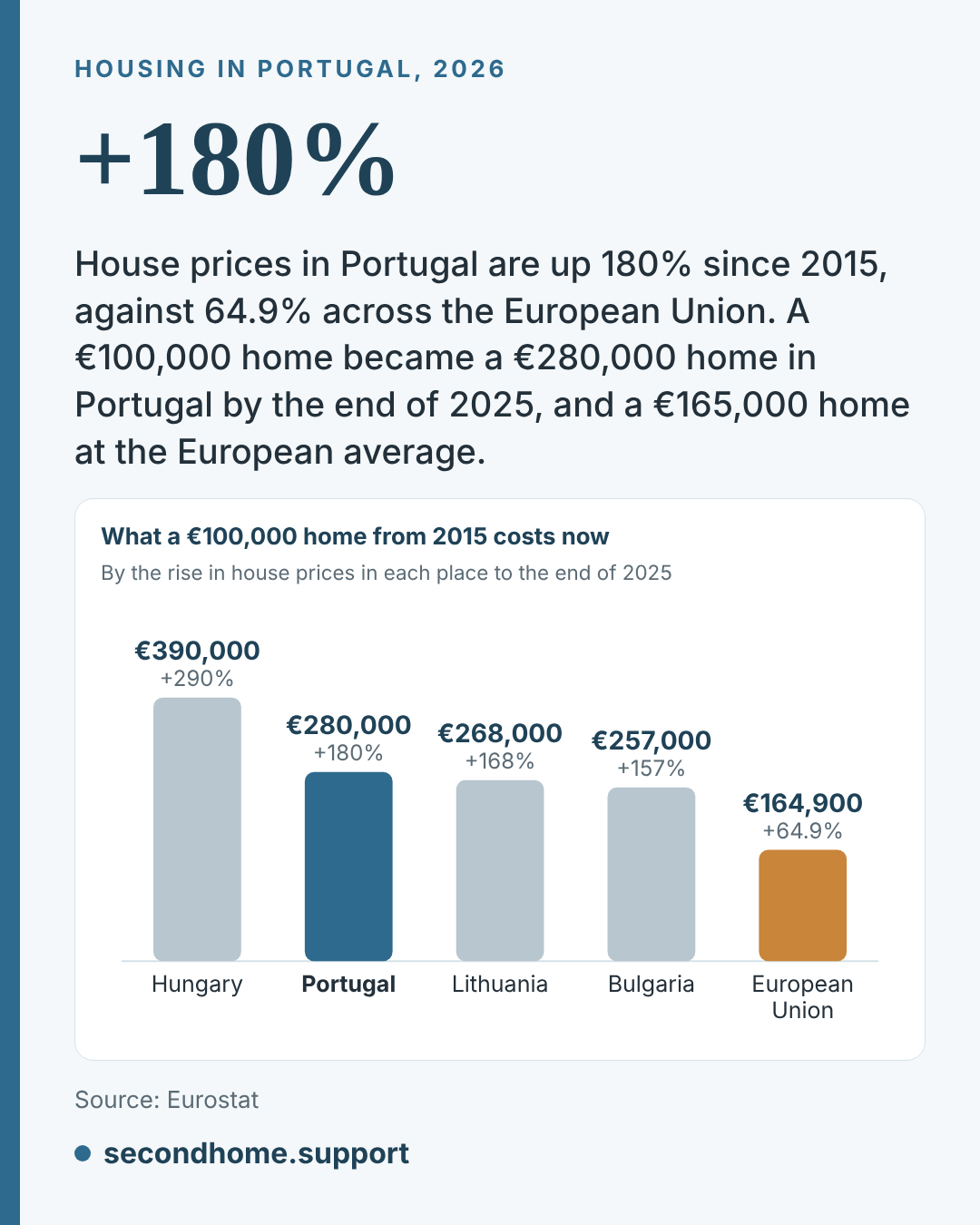
Only Hungary has risen more
Since 2015, prices in Portugal have nearly tripled. Across the European Union they are up by about two thirds.
In shortA home in Portugal costs 71% more than it did in 2020, and is on course to double.
Pay in Portugal: wages did not keep up
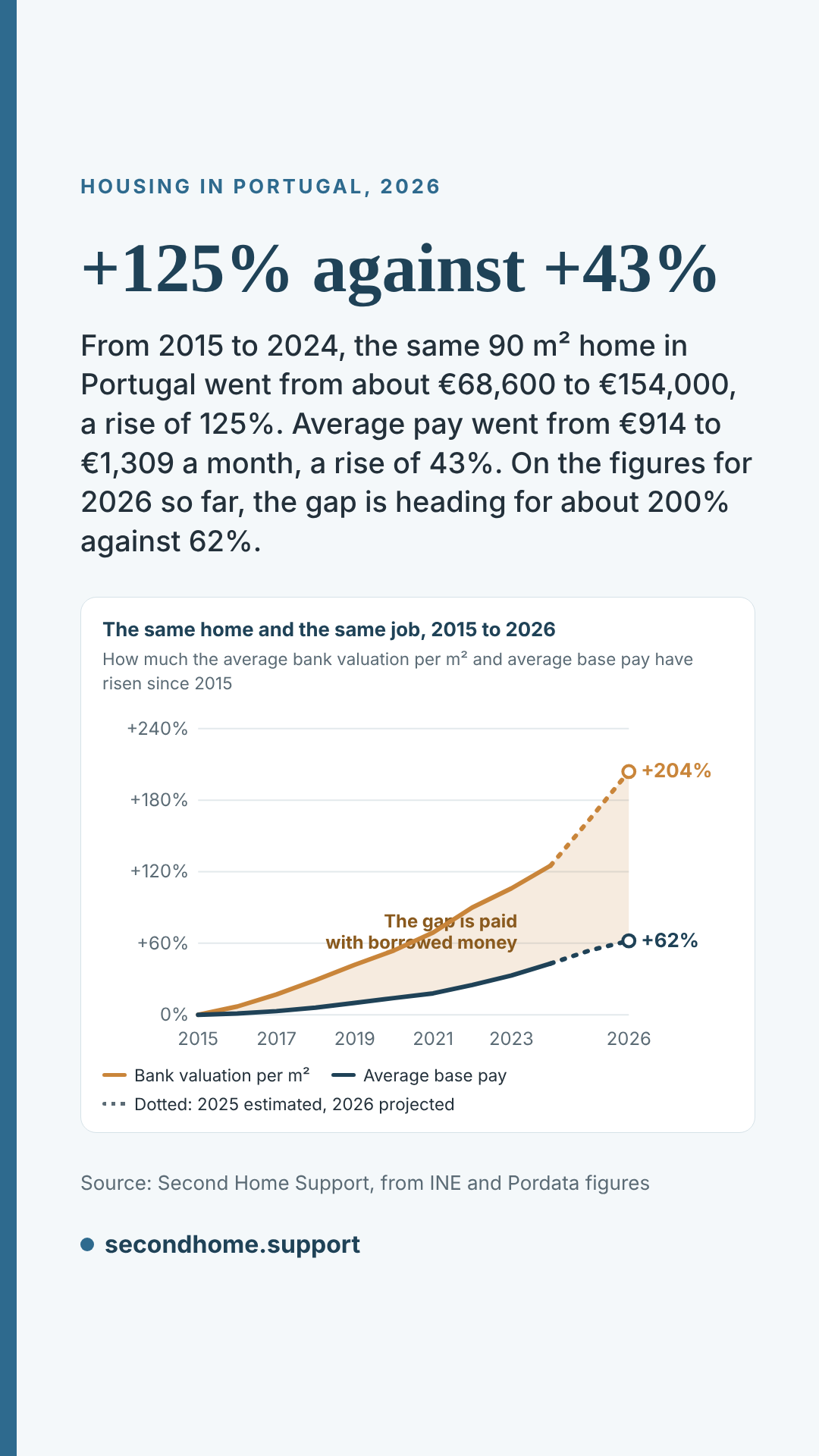
From 2015 to 2024, the same 90 m² home in Portugal went from about €68,600 to €154,000, a rise of 125%. Average pay went from €914 to €1,309 a month, a rise of 43%. On the figures for 2026 so far, the gap is heading for about 200% against 62%.
The same home and the same job, 2015 to 2026
How much the average bank valuation per m² and average base pay have risen since 2015
Source: Second Home Support, from INE and Pordata figuresData to: 2024, with 2026 projected · Next update: February 2027
secondhome.support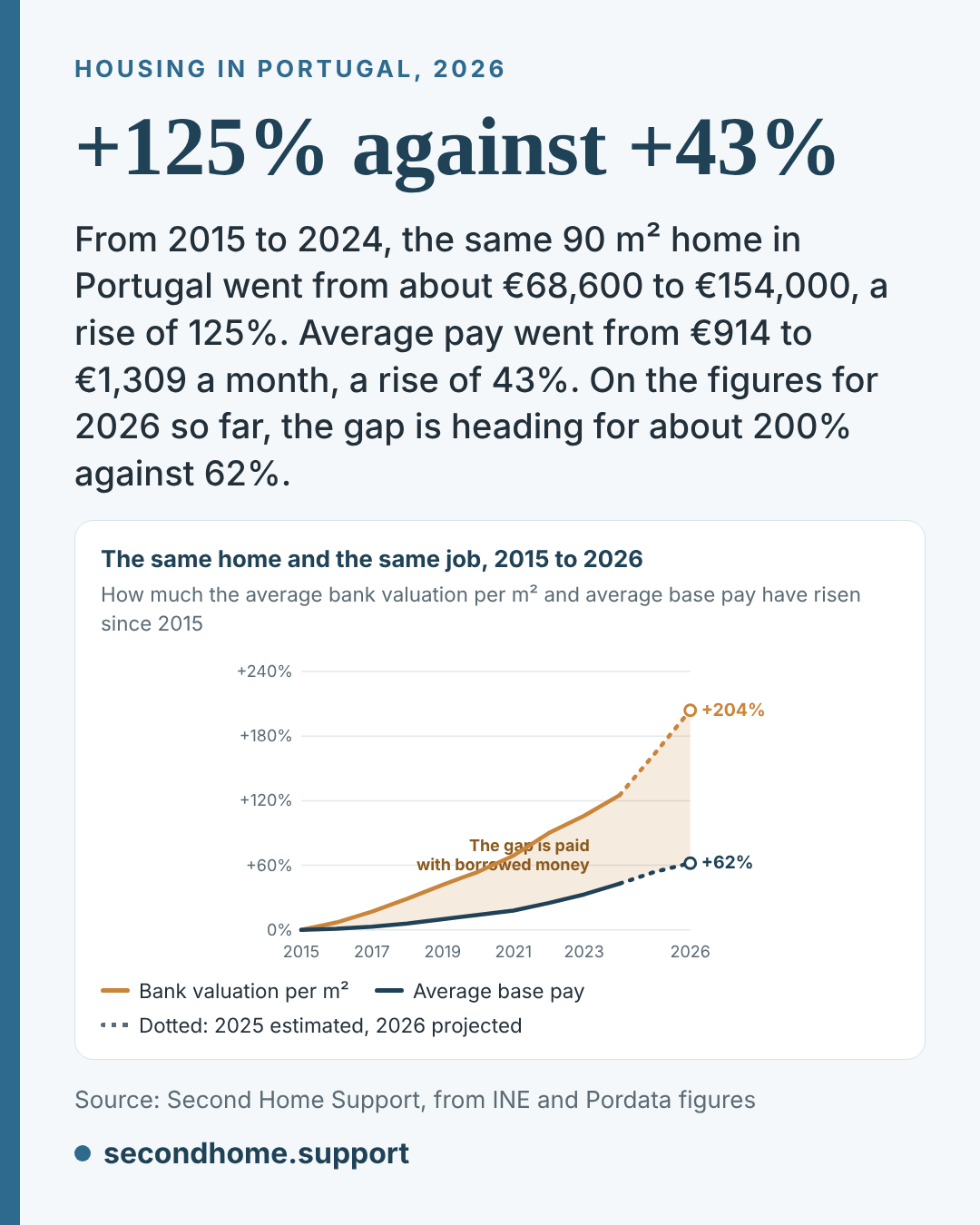
The home more than doubled. The pay rose by less than half.
In 2015, a 90 m² home at the average bank valuation came to about €68,600. In 2024, the same home came to about €154,000. Average base pay went from €914 to €1,309 a month over the same years. These are bank valuations, which run a little below the rise in sold prices.
Pay rose 5.6% in 2025
The average worker in Portugal earned €1,694 a month before tax in 2025, counting bonuses and overtime. That was 5.6% more than in 2024, or 3.2% more once inflation is taken out.
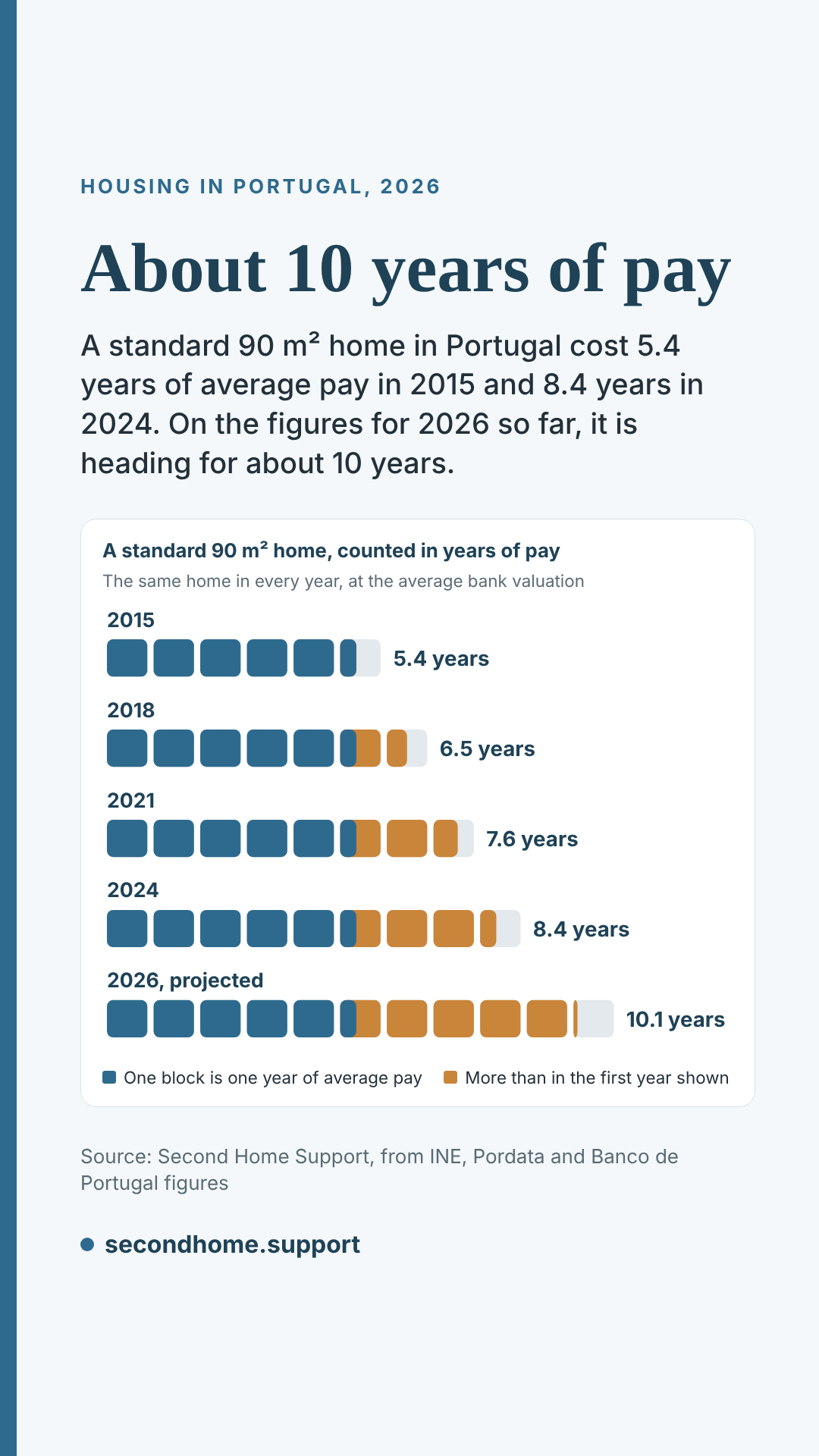
A standard 90 m² home in Portugal cost 5.4 years of average pay in 2015 and 8.4 years in 2024. On the figures for 2026 so far, it is heading for about 10 years.
A standard 90 m² home, counted in years of pay
The same home in every year, at the average bank valuation
Source: Second Home Support, from INE, Pordata and Banco de Portugal figuresData to: 2024, with 2026 projected · Next update: February 2027
secondhome.support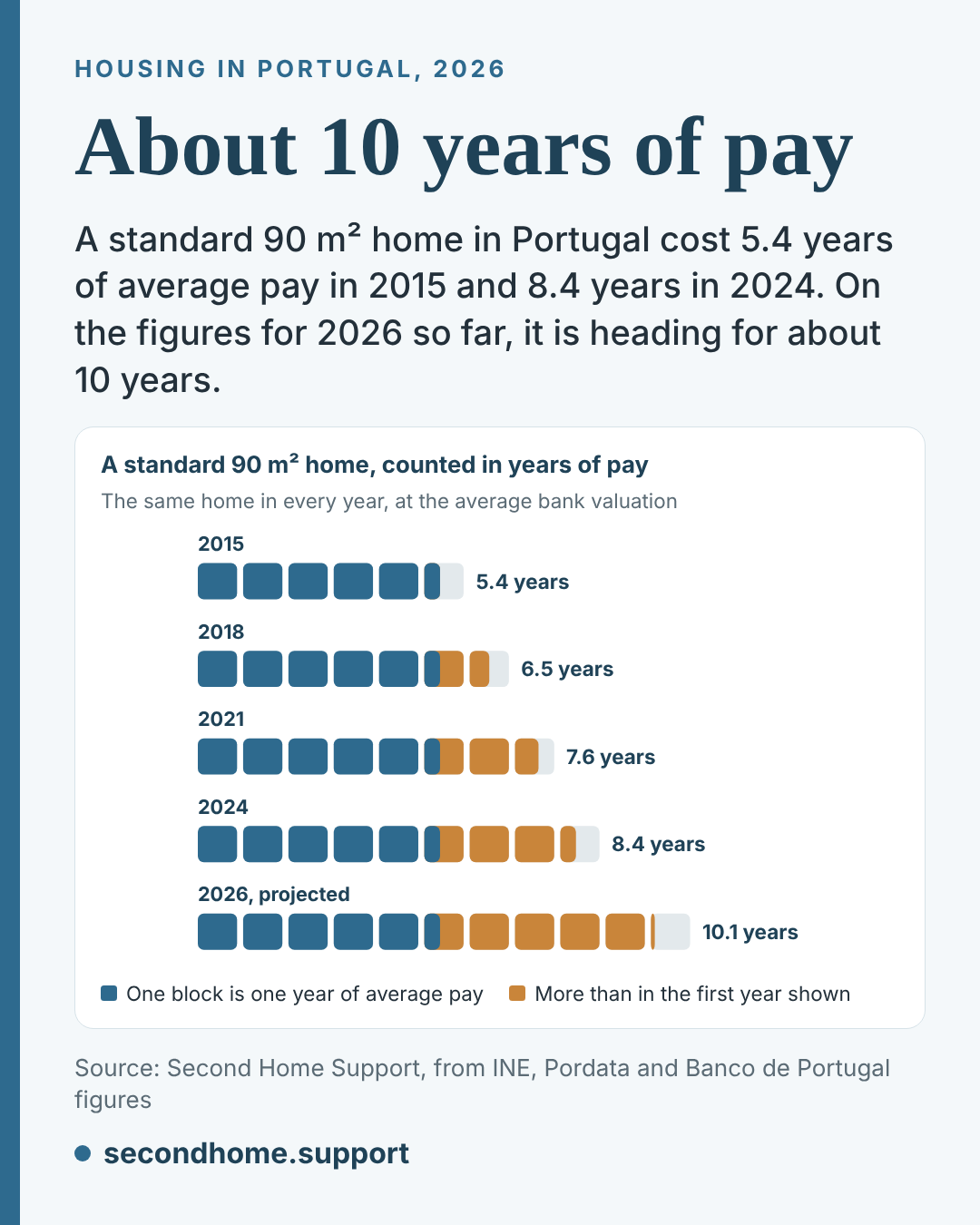
The same home, measured the same way every year
To compare one year with another we use the same home every time: 90 m² at the average bank valuation, bought with an 80% loan over 30 years at that year's average rate, set against average base pay, paid 14 times a year. On that measure a home cost 5.4 years of pay in 2015 and 8.4 years in 2024. This is a standard home, chosen so one year can be compared with another. The average home actually sold is larger and costs more: 11.9 years of pay in 2025.
Years of local average pay to buy a 90 m² home
By municipality. The 2025 column uses pay carried forward from 2024.
| Municipality | 2015 | 2019 | 2025 |
|---|---|---|---|
| Lisboa | 7.9 | 13.9 | 14.5 |
| Cascais | 7.6 | 13.1 | 16.0 |
| Faro | 6.7 | 9.8 | 12.5 |
| Porto | 6.2 | 10.2 | 11.4 |
| Braga | 4.9 | 6.1 | 8.2 |
Sources: INE bank valuations; BIS house price index; Pordata, average base pay; Banco de Portugal, average rate on new home loans. Calculation by Second Home Support.
secondhome.supportThe widest gap between prices and income in the European Union
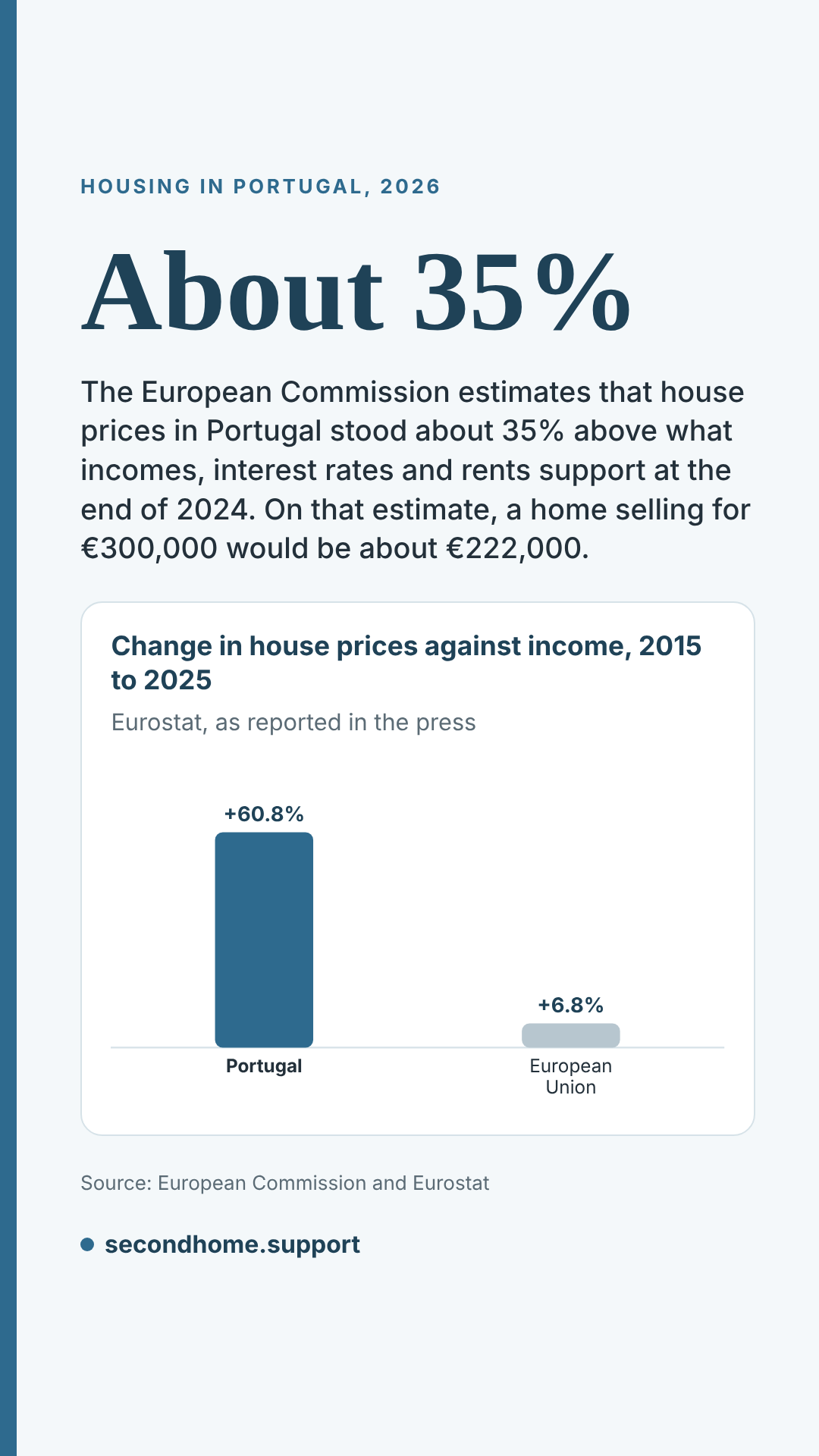
Eurostat reported on 9 November 2026 that the ratio of house prices to income rose 60.8% in Portugal between 2015 and 2025, the largest rise in the European Union, where the average was 6.8%. We take this figure from press coverage of the release and have not read it at the source.
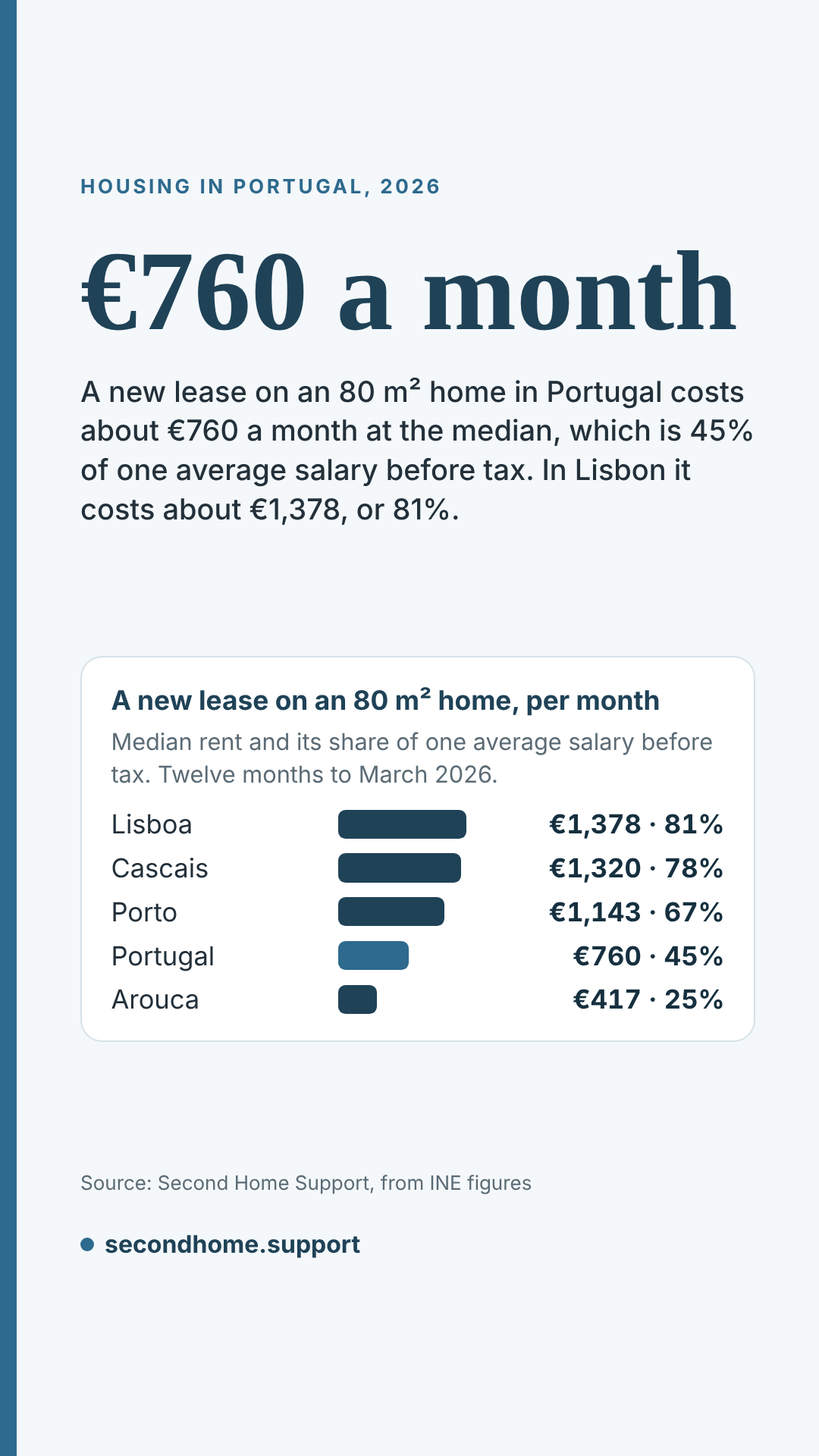
A new lease on an 80 m² home in Portugal costs about €760 a month at the median, which is 45% of one average salary before tax. In Lisbon it costs about €1,378, or 81%.
A new lease on an 80 m² home, per month
Median rent and its share of one average salary before tax. Twelve months to March 2026.
Source: Second Home Support, from INE figuresData to: March 2026 · Next update: December 2026
secondhome.support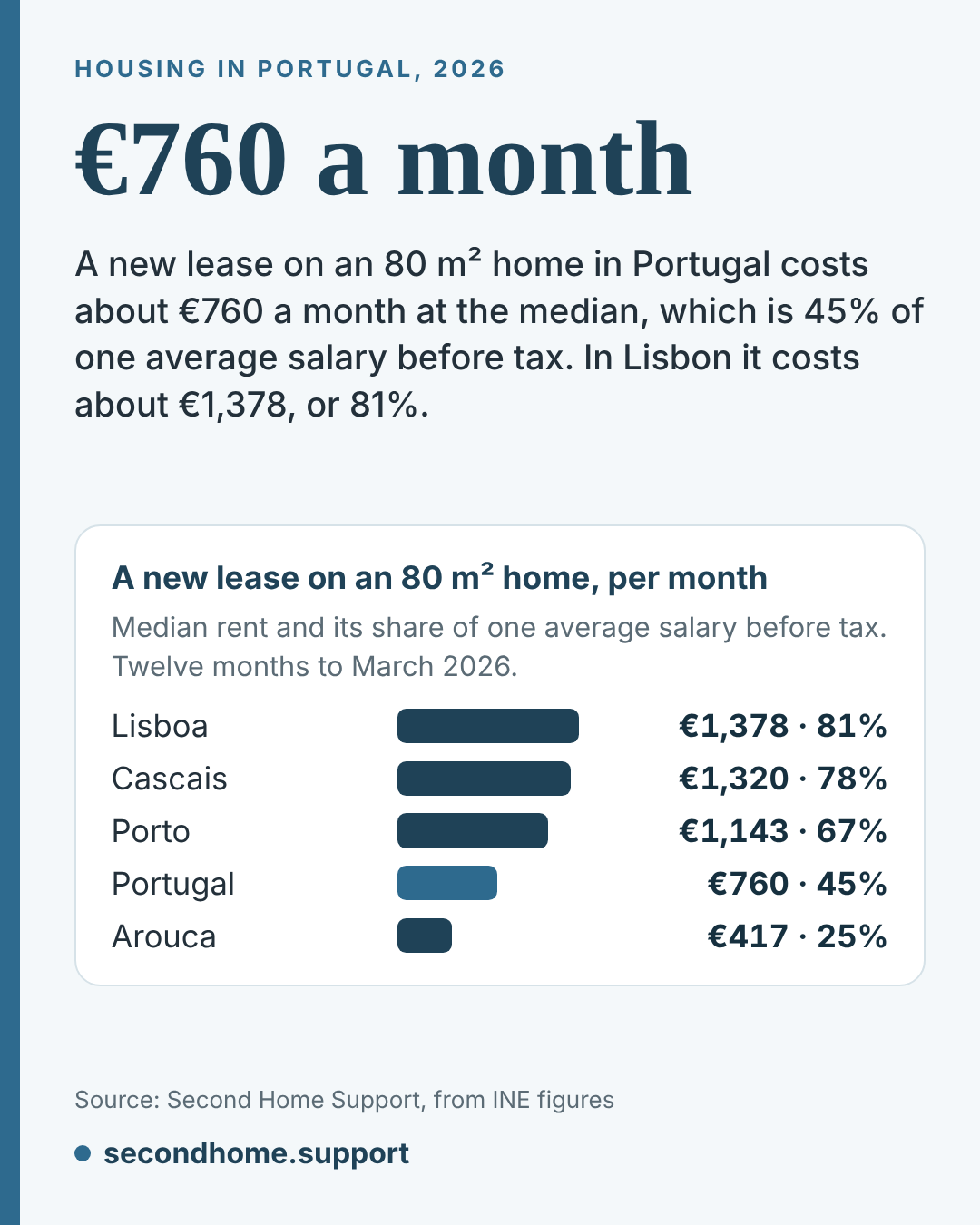
Renting is no way around it
At the median, a new lease on an 80 m² home takes 45% of one average salary before tax across Portugal, 67% in Porto and 81% in Lisbon. INE counts only new leases, from contracts registered with the tax authority. Over the twelve months to March 2026 the median new lease was €9.50 per m², 8.8% more than a year earlier. People on older contracts pay less, and their rents rise more slowly.
In shortSince 2015, the price of a home has risen about three times as fast as pay.
Mortgages in Portugal: so buyers borrow more
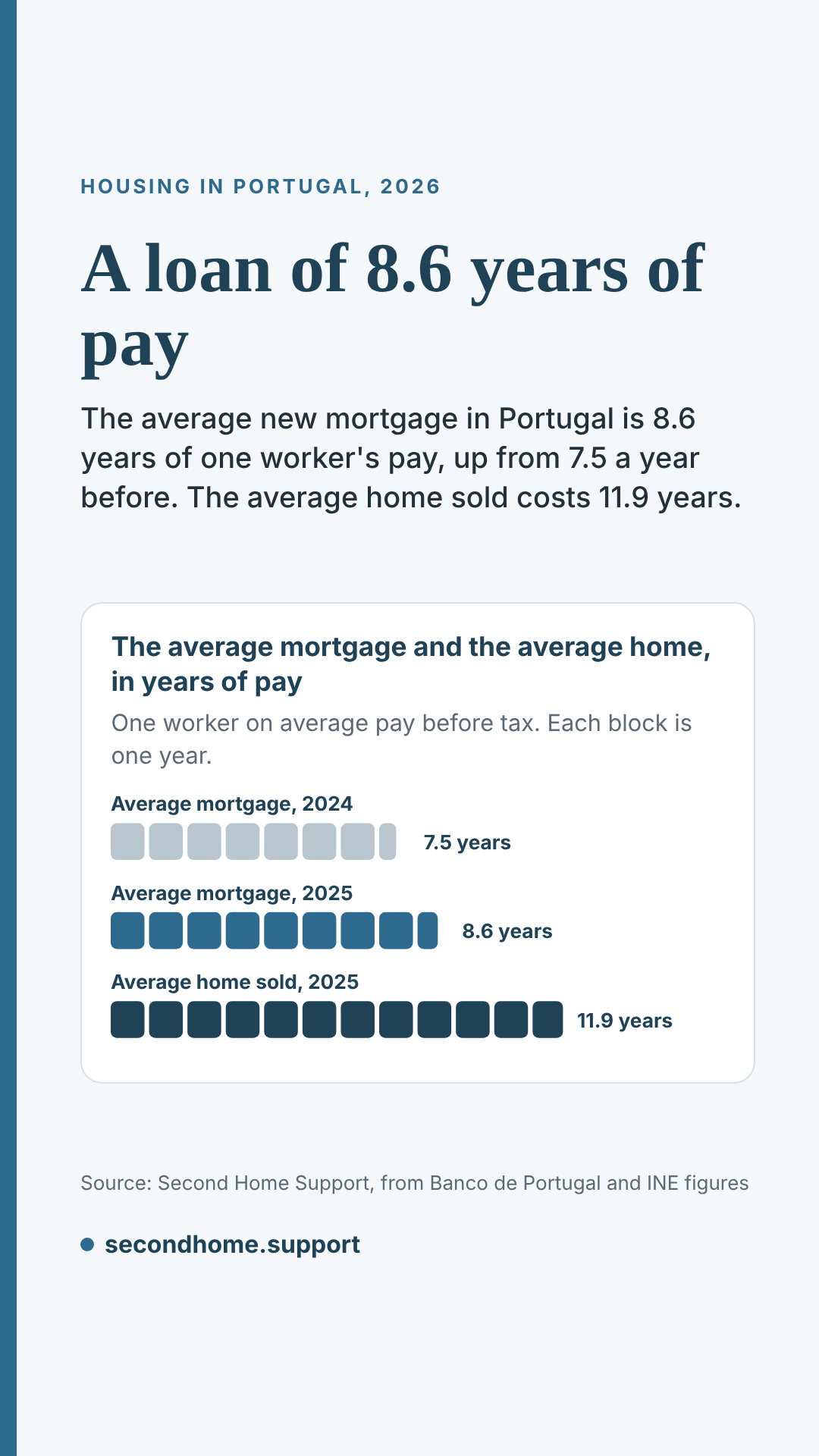
The average new mortgage in Portugal is 8.6 years of one worker's pay, up from 7.5 a year before. The average home sold costs 11.9 years.
The average mortgage and the average home, in years of pay
One worker on average pay before tax. Each block is one year.
Source: Second Home Support, from Banco de Portugal and INE figuresData to: 2025 · Next update: Spring 2027
secondhome.support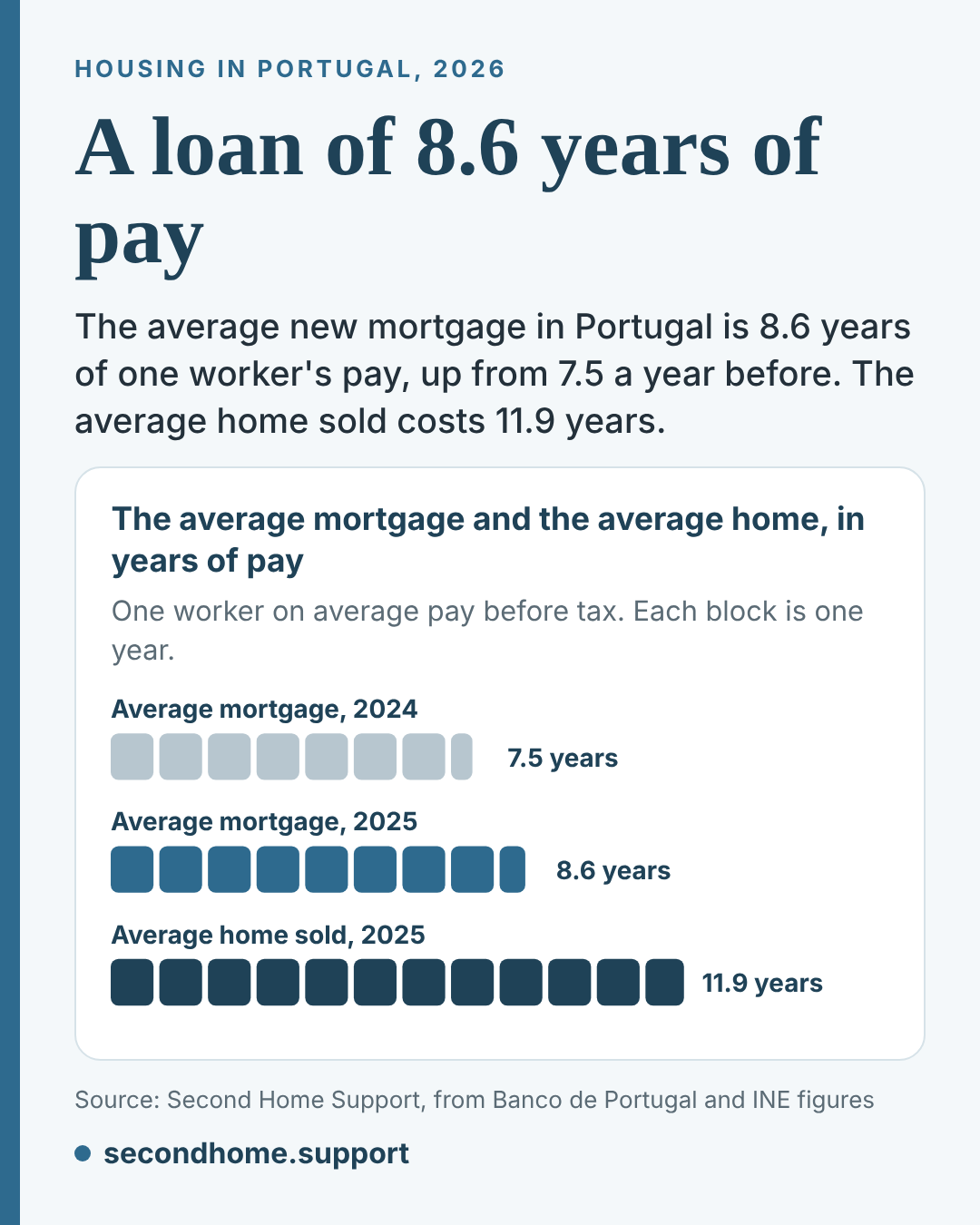
The difference comes from the bank
When the price rises faster than the pay, the difference has to come from somewhere. More than half of the money spent on homes is now borrowed.
The average mortgage is 8.6 years of pay, up from 7.5
Average gross pay was €1,694 a month in 2025, or about €20,300 a year. The average new mortgage was €175,141, which is 8.6 years of that pay. In 2024 the average mortgage was about €144,600 and pay about €19,250, which is 7.5 years. The average home sold, at about €242,000, cost 11.9 years of pay, up from 11.2. So the home took about eight more months of pay than a year before, and the loan took about thirteen more. Many mortgages are taken by two people, which halves these figures for a couple and leaves the rise the same.
Why loans grew faster than prices
The average new mortgage is all the money banks lent for homes in the year, divided by the number of loans. It rose 21.1%, against 17.6% for house prices and 5.6% for pay. Lending has kept growing in 2026: banks lent €18.9 billion for homes from January to September, 12% more than in the same months of 2025. Loans grew faster than prices because buyers are also borrowing a larger share of the price. The state guarantee for buyers under 35, which lets them borrow up to the full price, is part of that.
Of every €100 spent on homes in Portugal at the end of 2025, about €54 was borrowed from a bank, the most since 2011. Two years earlier it was about €33.
Where each €100 spent on homes comes from
All homes sold, including those bought without a loan
Source: Banco de PortugalData to: December 2025 · Next update: Spring 2027
secondhome.support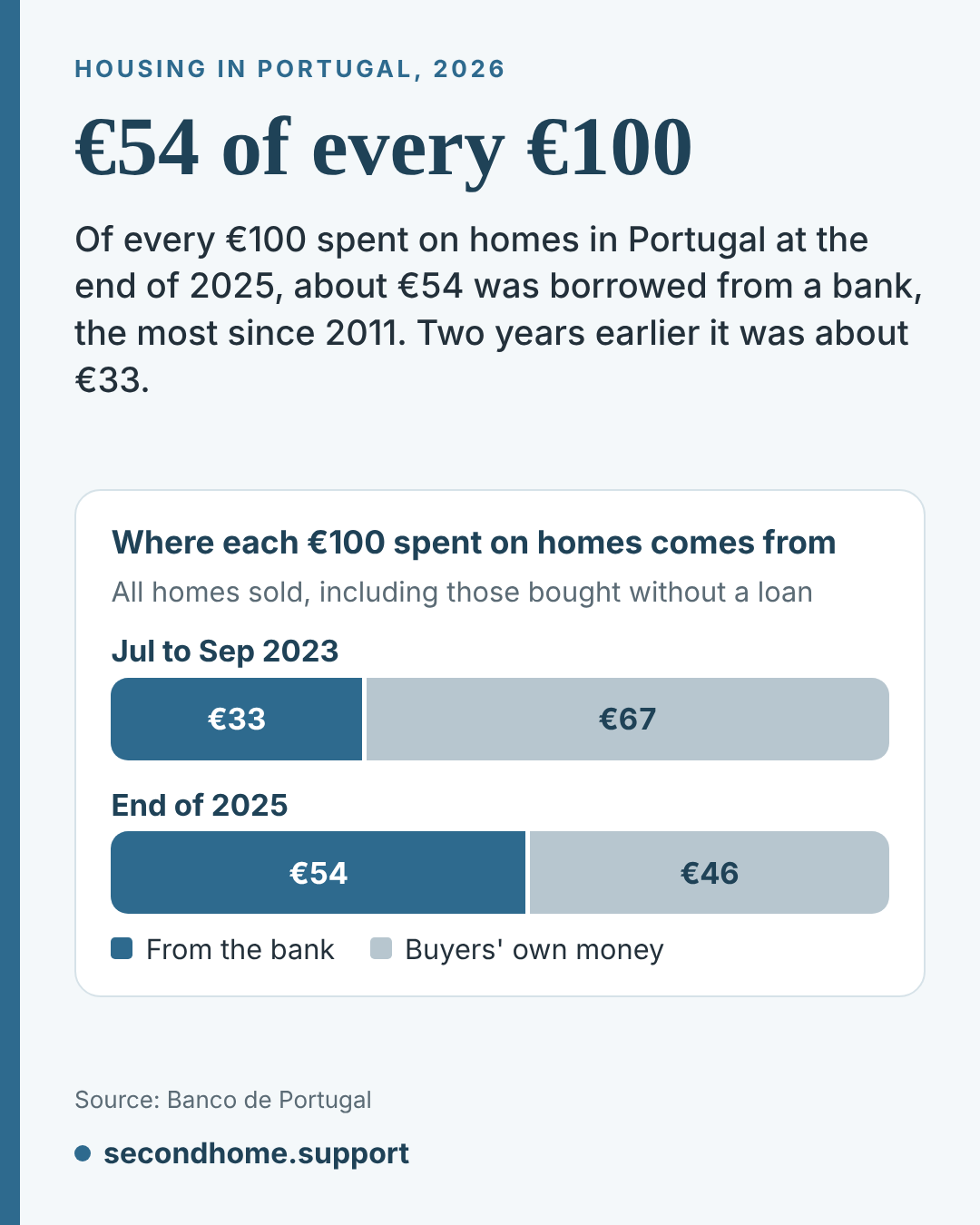
Banks now pay for more than half of what is spent on homes
Banco de Portugal counted 133,602 new home loans in 2025, 11.5% more than the year before, for about €23.4 billion in total. Leaving out loans moved from one bank to another, new lending came to 53.6% of the value of all homes sold at the end of 2025. In late 2023 it was 32.5%. The rest is paid from savings, from the sale of another home, or with money from abroad. This counts every sale together, including homes bought with no loan at all. A buyer who does borrow covers a much larger share of the price with the loan.
The monthly loan payment on the same 90 m² home in Portugal was about €291 in 2021 and €608 in 2025, and is heading for about €700 in 2026. Rates came down after 2023 and have been rising again since the spring of 2026. The price rose all the way through.
The rate fell. The payment did not.
A 90 m² home at the average bank valuation, with an 80% loan over 30 years
* 2026 is projected: the rate is September 2026 and the valuation follows the rise recorded to September.
Source: Second Home Support, from Banco de Portugal and INE figuresData to: September 2026 · Next update: December 2026
secondhome.support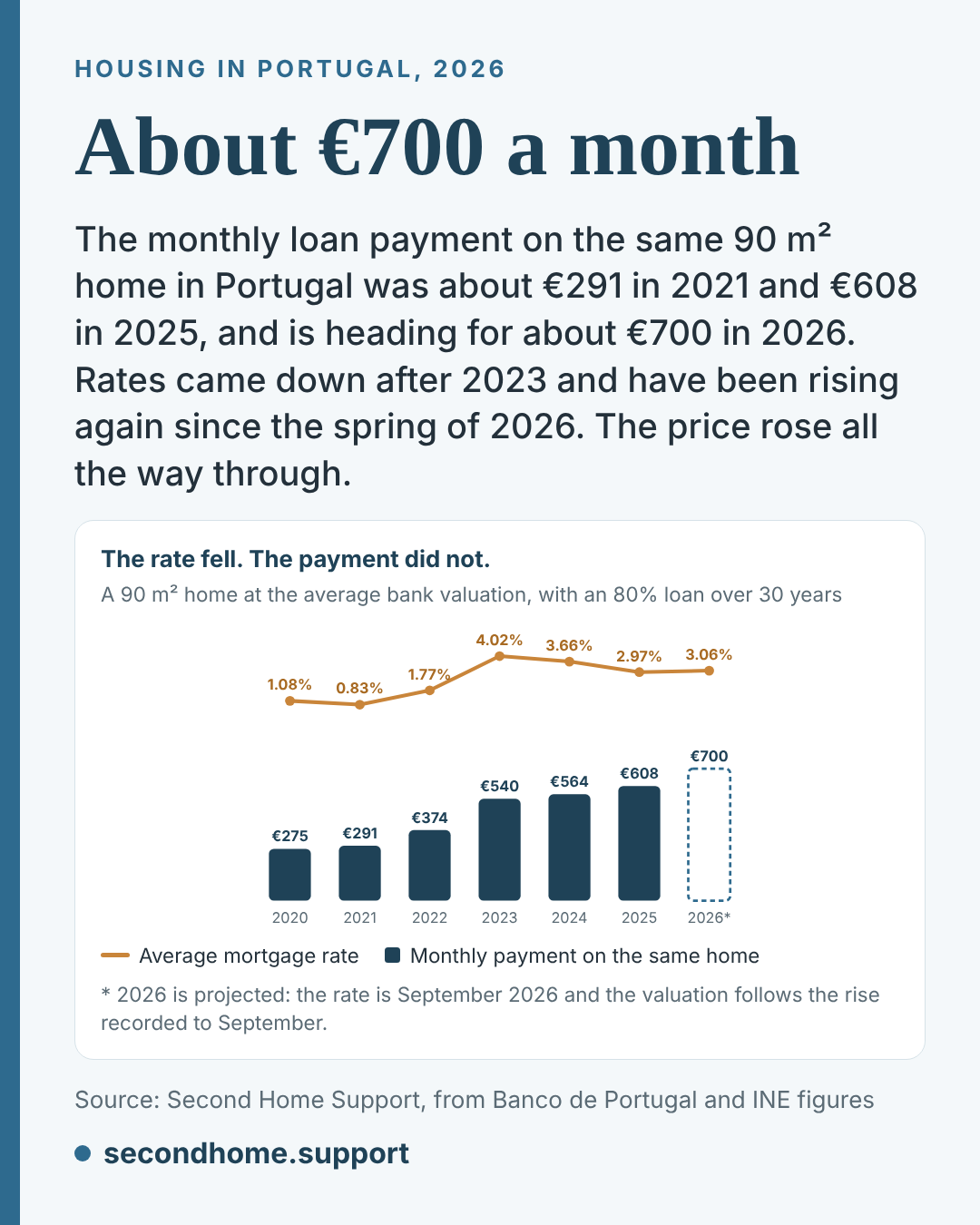
Cheaper credit did not make a home easier to afford
The average mortgage rate fell from 4.02% in 2023 to 2.97% in 2025, and prices rose by enough to cancel it out. By September 2026 the rate on new loans was back up to 3.06%, after six monthly rises. The payment on the same home was about €540 a month when rates peaked in 2023 and about €608 in 2025. It takes about 37% of average pay in both years.
In shortBuyers borrow more than they did, and the monthly payment has more than doubled since 2021.
Who is buying homes in Portugal
Who counts as a foreign buyer depends on how you count
- Resident for tax in Portugal. The buyer's tax address is in Portugal. INE defines that address as the place where the person usually lives. Foreign citizens who have moved to Portugal are counted here. As a general rule, a person becomes resident for tax after more than 183 days in Portugal in a year, or by keeping a home here as their usual residence.
- Resident abroad. The buyer's tax address is outside Portugal. This covers foreign buyers of second homes and investments, and also Portuguese citizens who live in another country.
- Born outside Portugal. A separate count, by place of birth, for homes bought by households. INE records where the buyer was born, and not which passport the buyer holds. So this count includes people who have lived in Portugal for many years, and it can include Portuguese citizens who were born abroad. INE's release does not break buyers down by nationality.
Of every 20 homes sold in Portugal, 19 go to someone who lives in Portugal. Buyers living abroad bought 5.0% of homes in 2025 and 4.7% in the second quarter of 2026.
Homes bought in 2025, by where the buyer is resident for tax
Each square is one home in every hundred sold
Source: INEData to: June 2026 · Next update: December 2026
secondhome.support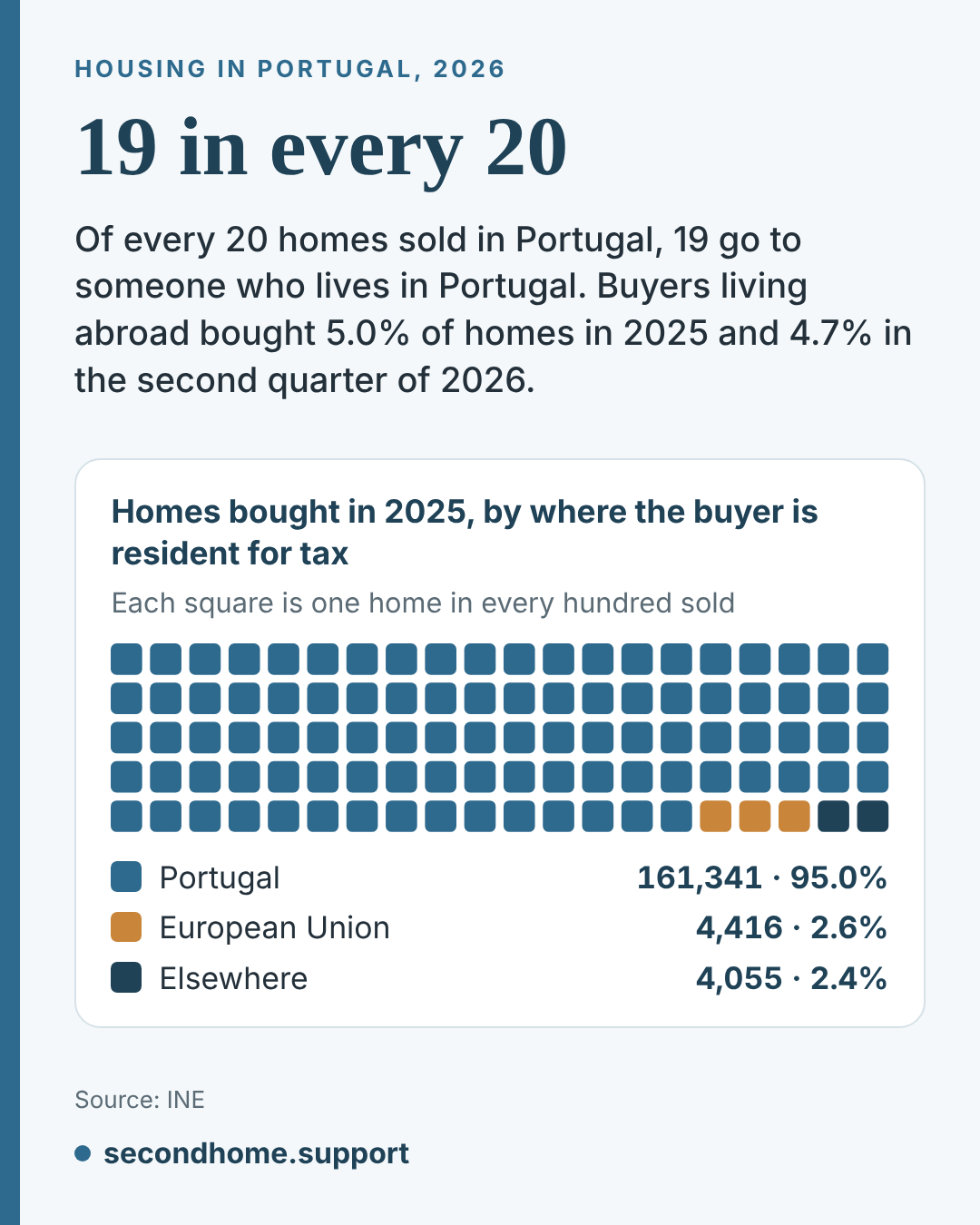
One sale in twenty goes to a buyer living abroad
INE knows where each buyer lives for tax. In 2025, 161,341 homes went to people living in Portugal and 8,471 to people living abroad. That second number was 13.3% lower than in 2024 and has fallen three years in a row. Buyers living abroad are one sale in twenty. They spend more on each home, so they account for 8.2% of the money.
Average price paid, by where the buyer is resident for tax
2025
Source: INE, House Price Index, fourth quarter of 2025.
secondhome.supportBuyers living abroad pay more because they buy different homes in different places
In the Algarve, buyers living abroad bought one home in five and paid 31.3% of the money spent. The Algarve figures reach us through a news report.
Of every 100 homes bought by households in Portugal in 2025, about 28 went to buyers born abroad. About 85% of those buyers live in Portugal.
Homes bought by households in 2025, by where the buyer was born and lives
Each house is one in every hundred homes bought by households
Source: INEData to: 2025 · Next update: March 2027
secondhome.support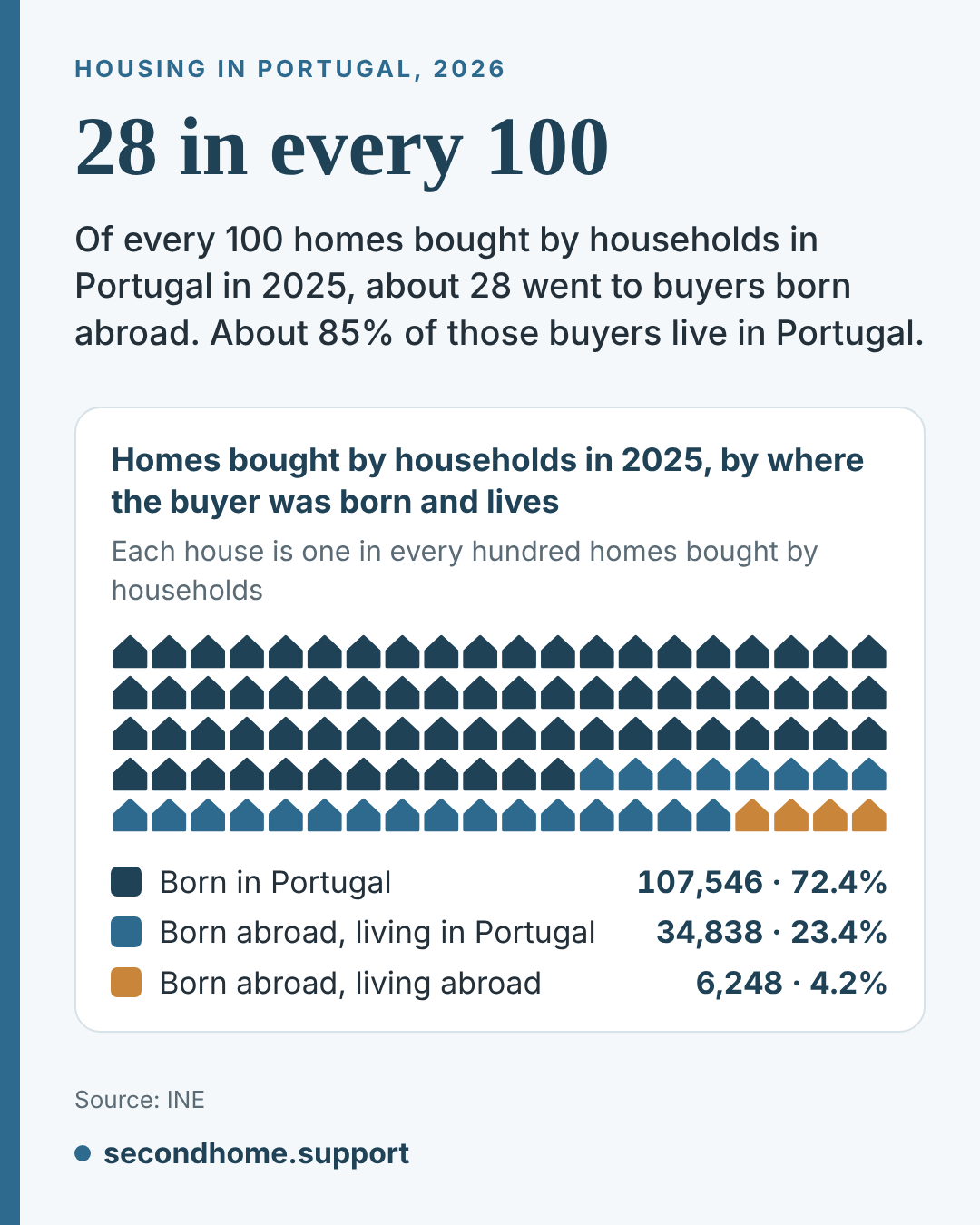
By place of birth, the numbers look different
People born outside Portugal bought 41,086 homes, which is 27.6% of the 148,632 homes bought by households. Of those buyers, 34,838 live in Portugal and 6,248 live abroad. The largest groups were born in Brazil (9,808 homes), Angola (4,145) and France (3,765).
Place of birth is not nationality
INE takes place of birth from tax records, and a Portuguese citizen born in Luanda or Paris is in these numbers too. Another 2,024 homes went to people born in Portugal who now live abroad. Households bought 87.5% of all homes sold. Companies and other bodies bought the rest.
In shortNineteen in every twenty homes go to people who live in Portugal.
Where house prices rose most
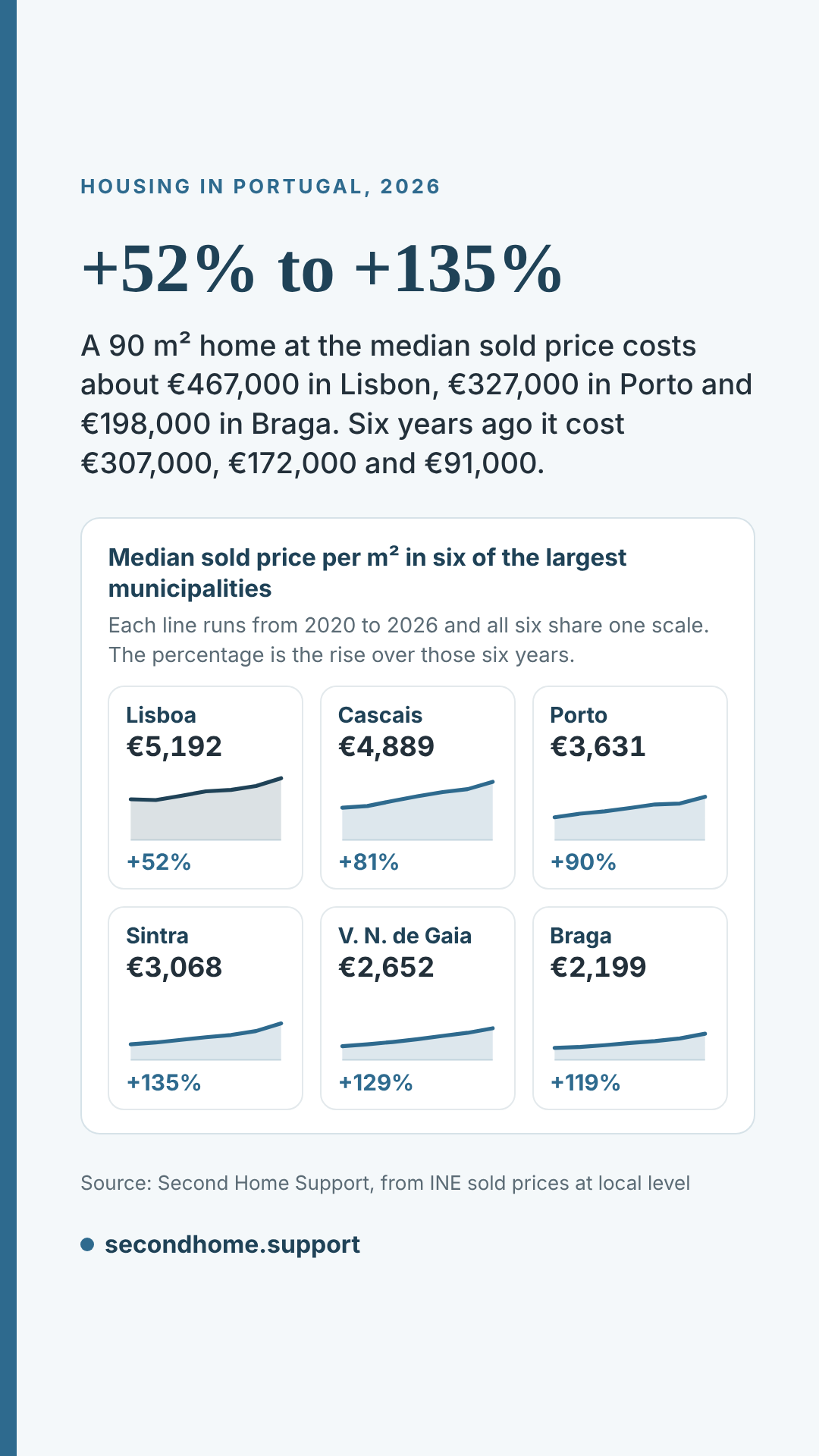
A 90 m² home at the median sold price costs about €467,000 in Lisbon, €327,000 in Porto and €198,000 in Braga. Six years ago it cost €307,000, €172,000 and €91,000.
Median sold price per m² in six of the largest municipalities
Each line runs from 2020 to 2026 and all six share one scale. The percentage is the rise over those six years.
Source: Second Home Support, from INE sold prices at local levelData to: June 2026 · Next update: Early 2027
secondhome.support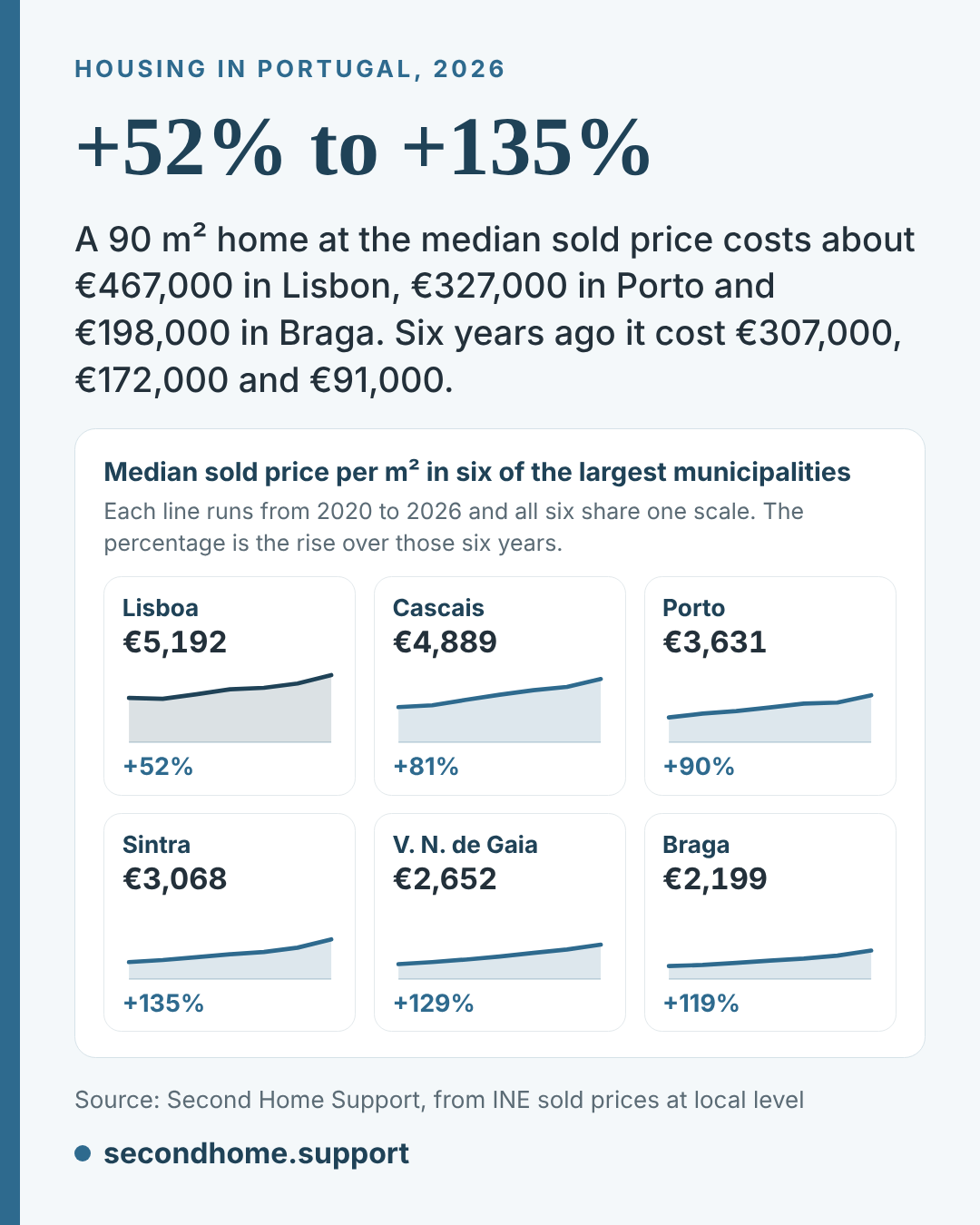
Lisbon costs the most and rose the least
Lisbon is at a median of €5,192 per m², ahead of Cascais at €4,889. Porto is at €3,631 and Braga at €2,199. Sintra rose the most of the six.
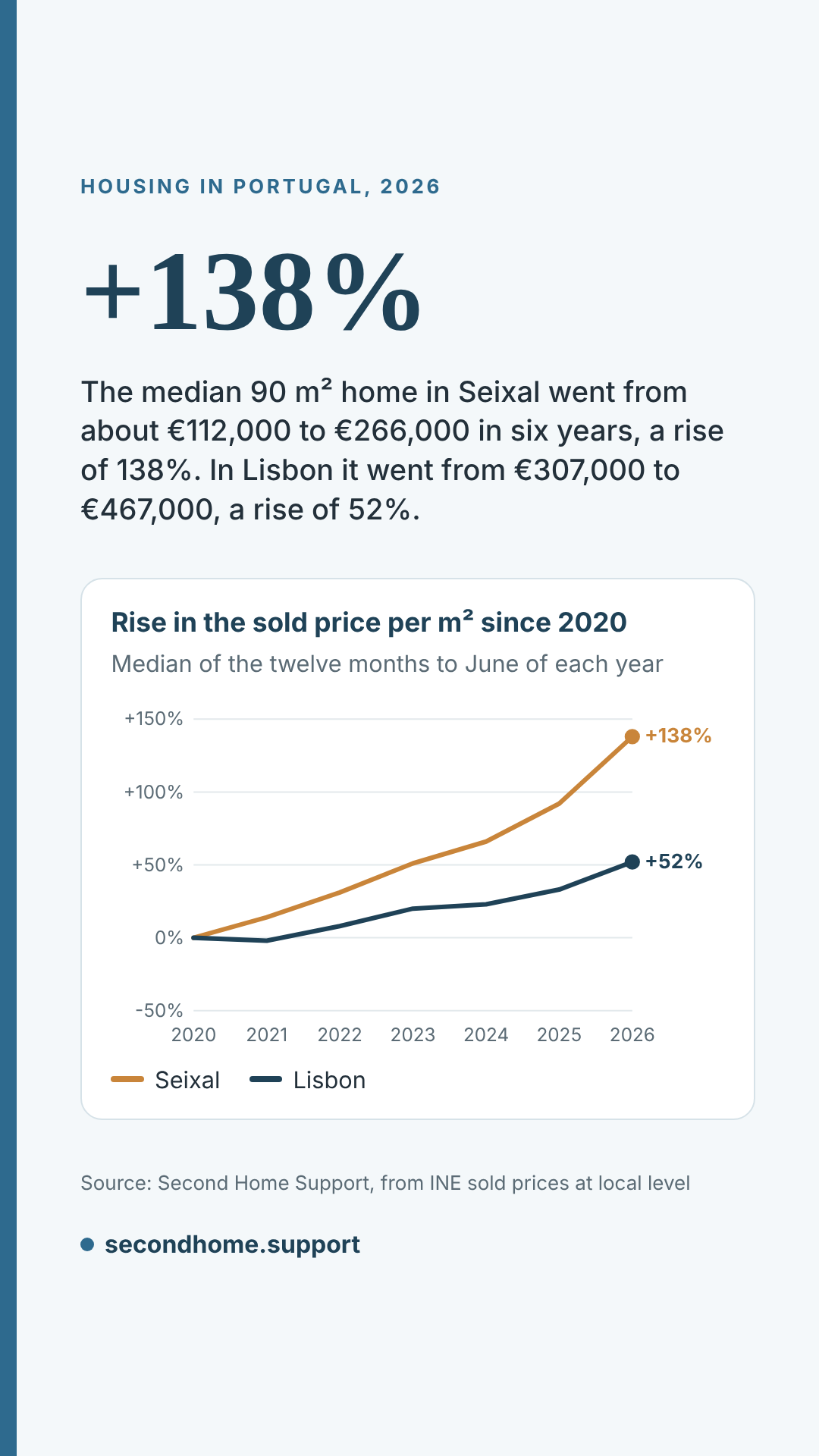
The median 90 m² home in Seixal went from about €112,000 to €266,000 in six years, a rise of 138%. In Lisbon it went from €307,000 to €467,000, a rise of 52%.
Rise in the sold price per m² since 2020
Median of the twelve months to June of each year
Source: Second Home Support, from INE sold prices at local levelData to: June 2026 · Next update: Early 2027
secondhome.support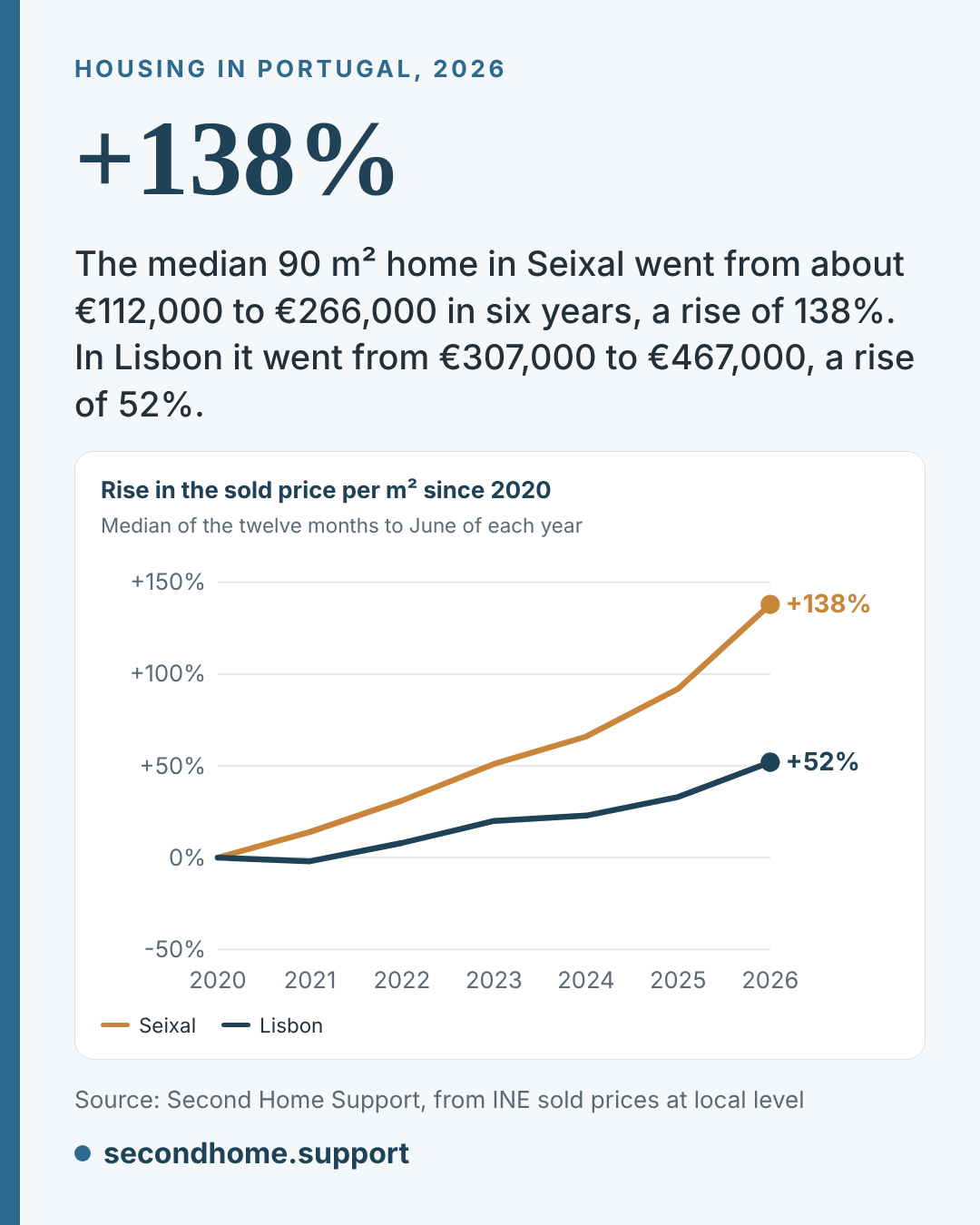
The steepest rises are in the towns around Lisbon and Porto
Prices in those towns started much lower than in the center of Lisbon. Seixal, Sintra and Setúbal each rose more than 130% in six years. Lisbon rose 52%, from the highest starting point.
Median sold price per m², by municipality
Twelve months to June 2026, with the change since the twelve months to June 2020
| Municipality | To June 2020 | To June 2026 | Change |
|---|---|---|---|
| Lisboa | €3,414 | €5,192 | +52% |
| Cascais | €2,708 | €4,889 | +81% |
| Oeiras | €2,302 | €4,438 | +93% |
| Loulé | €2,233 | €4,137 | +85% |
| Porto | €1,911 | €3,631 | +90% |
| Odivelas | €1,948 | €3,595 | +85% |
| Loures | €1,699 | €3,421 | +101% |
| Almada | €1,615 | €3,387 | +110% |
| Amadora | €1,611 | €3,315 | +106% |
| Matosinhos | €1,566 | €3,183 | +103% |
| Faro | €1,707 | €3,150 | +85% |
| Sintra | €1,307 | €3,068 | +135% |
| Seixal | €1,240 | €2,957 | +138% |
| Setúbal | €1,182 | €2,760 | +134% |
| Vila Nova de Gaia | €1,156 | €2,652 | +129% |
| Aveiro | €1,209 | €2,391 | +98% |
| Évora | €1,268 | €2,327 | +84% |
| Coimbra | €1,302 | €2,295 | +76% |
| Braga | €1,006 | €2,199 | +119% |
| Leiria | €1,000 | €1,990 | +99% |
| Guimarães | €894 | €1,859 | +108% |
| Viseu | €958 | €1,627 | +70% |
| Beja | €706 | €1,277 | +81% |
Source: INE, Statistics on House Prices at Local Level. Mainland municipalities. Prices are per m² of gross private area.
secondhome.supportThese are sold prices, not asking prices
They are medians of what homes actually sold for, as recorded by the tax authority. Ten of the 23 municipalities in the table more than doubled.
In shortThe cheaper areas around the big cities rose the most.
How many homes are selling
In the second quarter of 2026, 441 homes were sold in Portugal every day, at about €267,000 each. That is 6.4% fewer homes than a year before, for 4.2% more money. In 2025 it was 465 a day.
Homes sold each year
With the total value
Source: INEData to: June 2026 · Next update: December 2026
secondhome.support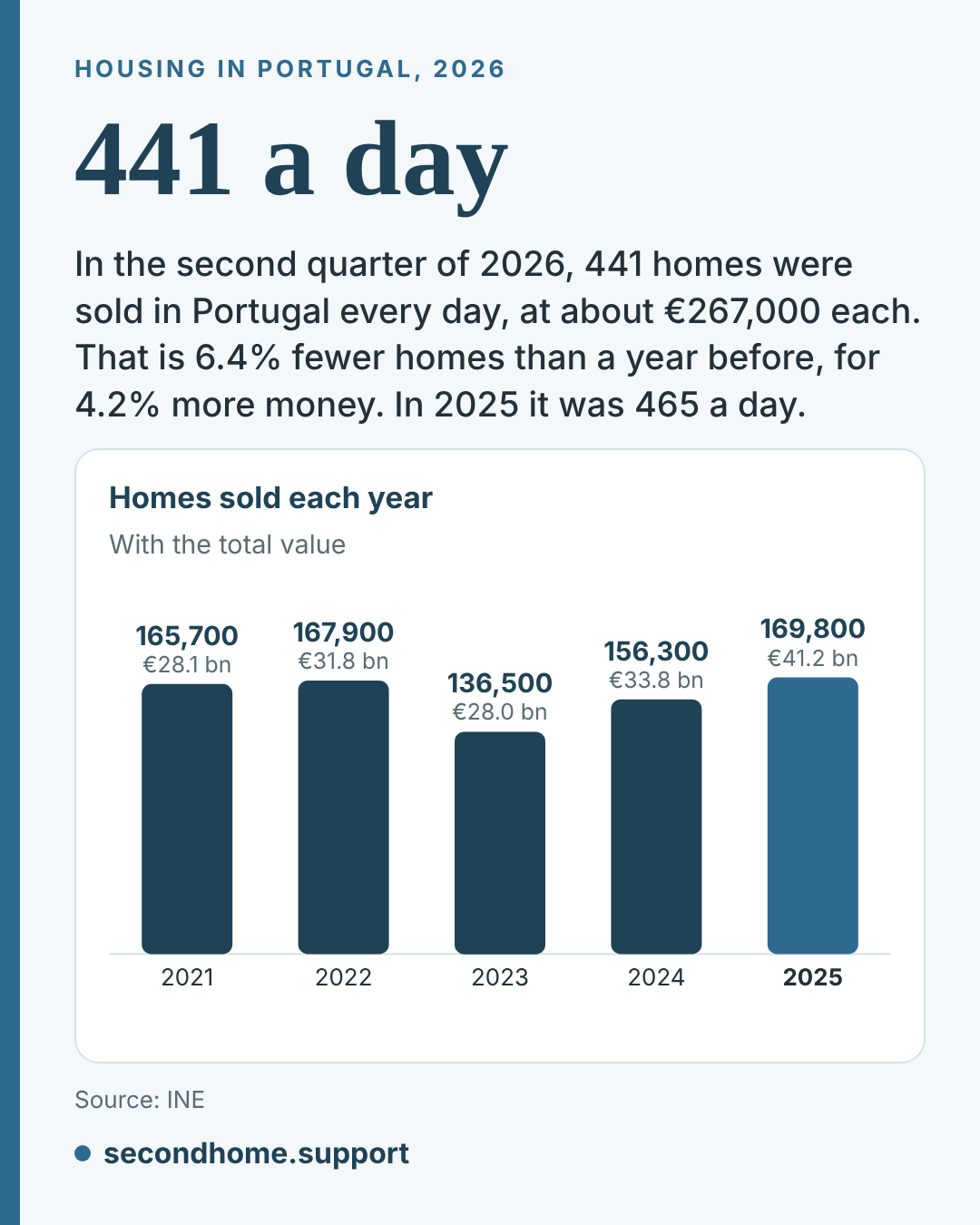
Fewer homes are selling in 2026, for more money
Sales fell 12.4% in the first quarter of 2026 and 6.4% in the second, against a year earlier, while the money spent kept rising. More homes sold in 2025 than in 2024, and for more money: 8.6% more homes and 21.7% more spent. The average sale was €242,399. Sales had dropped in 2023, when mortgage rates were at their highest since 2008, and have risen in both years since.
Four in five homes sold in Portugal in 2025 had been lived in before. One in five was new.
Homes sold in 2025, by kind of home
New means never lived in before
Source: INEData to: 2025 · Next update: March 2027
secondhome.support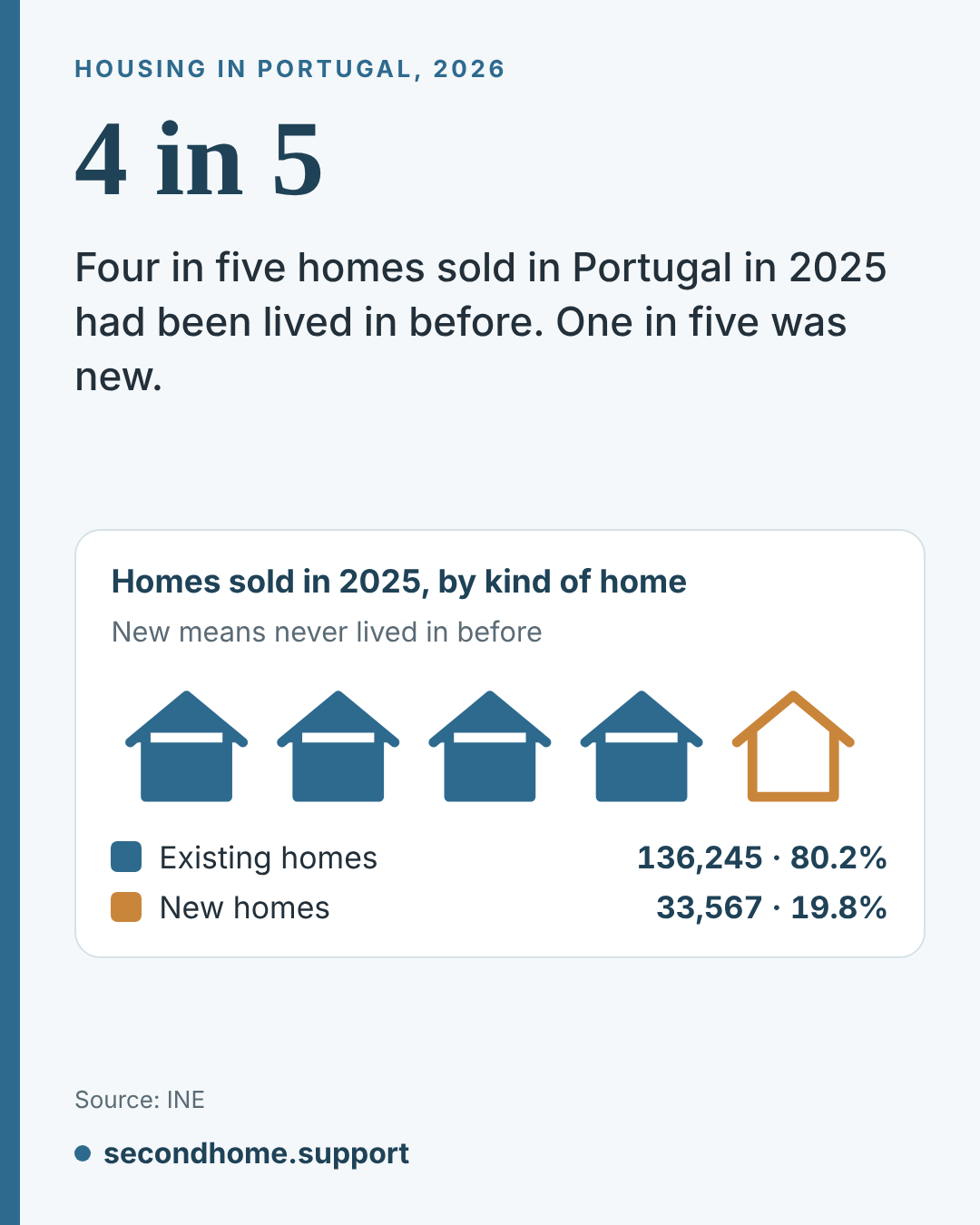
Nobody publishes who sells
INE records each sale by its buyer and says nothing about the seller, so there is no official count of homes sold by families, companies, heirs or owners who live abroad. What we do know is the kind of home: 136,245 of the homes sold in 2025 had been lived in before, and 33,567 were new.
In shortFewer homes are selling in 2026, at higher prices.
Are house prices in Portugal too high?
The European Commission estimates that house prices in Portugal stood about 35% above what incomes, interest rates and rents support at the end of 2024. On that estimate, a home selling for €300,000 would be about €222,000.
Change in house prices against income, 2015 to 2025
Eurostat, as reported in the press
Source: European Commission and EurostatData to: December 2024 · Next update: When the European Commission next publishes
secondhome.support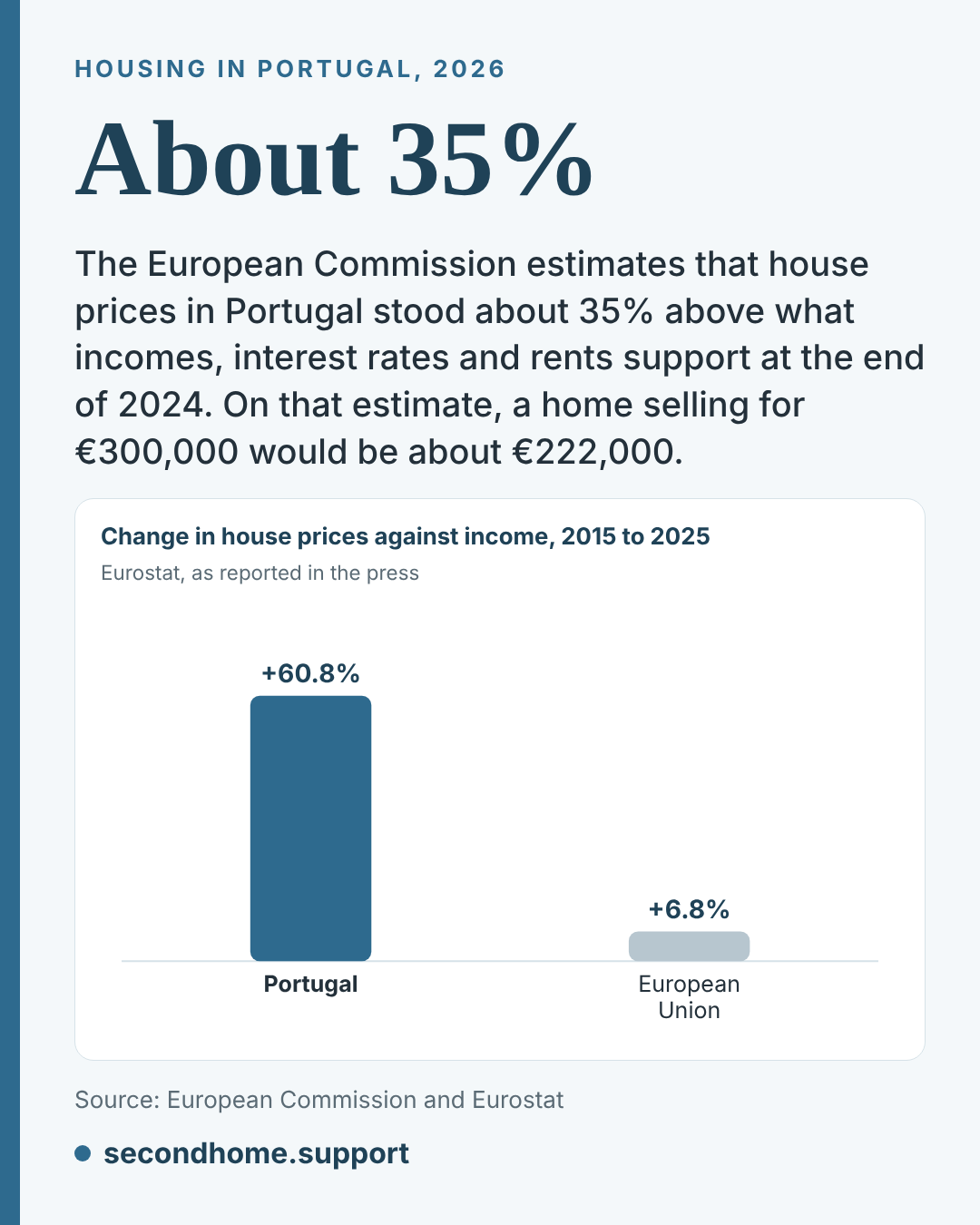
What overvalued means
Overvalued means prices are higher than incomes, interest rates, rents and the number of homes can explain. The figure comes from a model, so two institutions can look at the same market and give two different numbers.
The European Commission puts it at about 35%
The European Commission's figure for Portugal was about 35% at the end of 2024, the highest in the European Union. Portugal was also the only country where it rose significantly that year. The Commission averages three measures: prices against household income, prices against rents, and a model that ties prices to income, interest rates and the supply of homes. We take this figure from press coverage of the Commission's report.
Banco de Portugal runs seven tests
We could not find a single figure from the bank. It runs seven tests and reports whether they agree. Two compare prices with income and with rents, each against its own long run average. One compares real prices with their long run trend. Three are models that tie prices to income, unemployment, interest rates and house building. The last looks for prices that are feeding on their own rise. When at least five of the seven agree, the bank calls the market overvalued. It has done so since early 2018, and in May 2026 it named a fall in house prices as a risk.
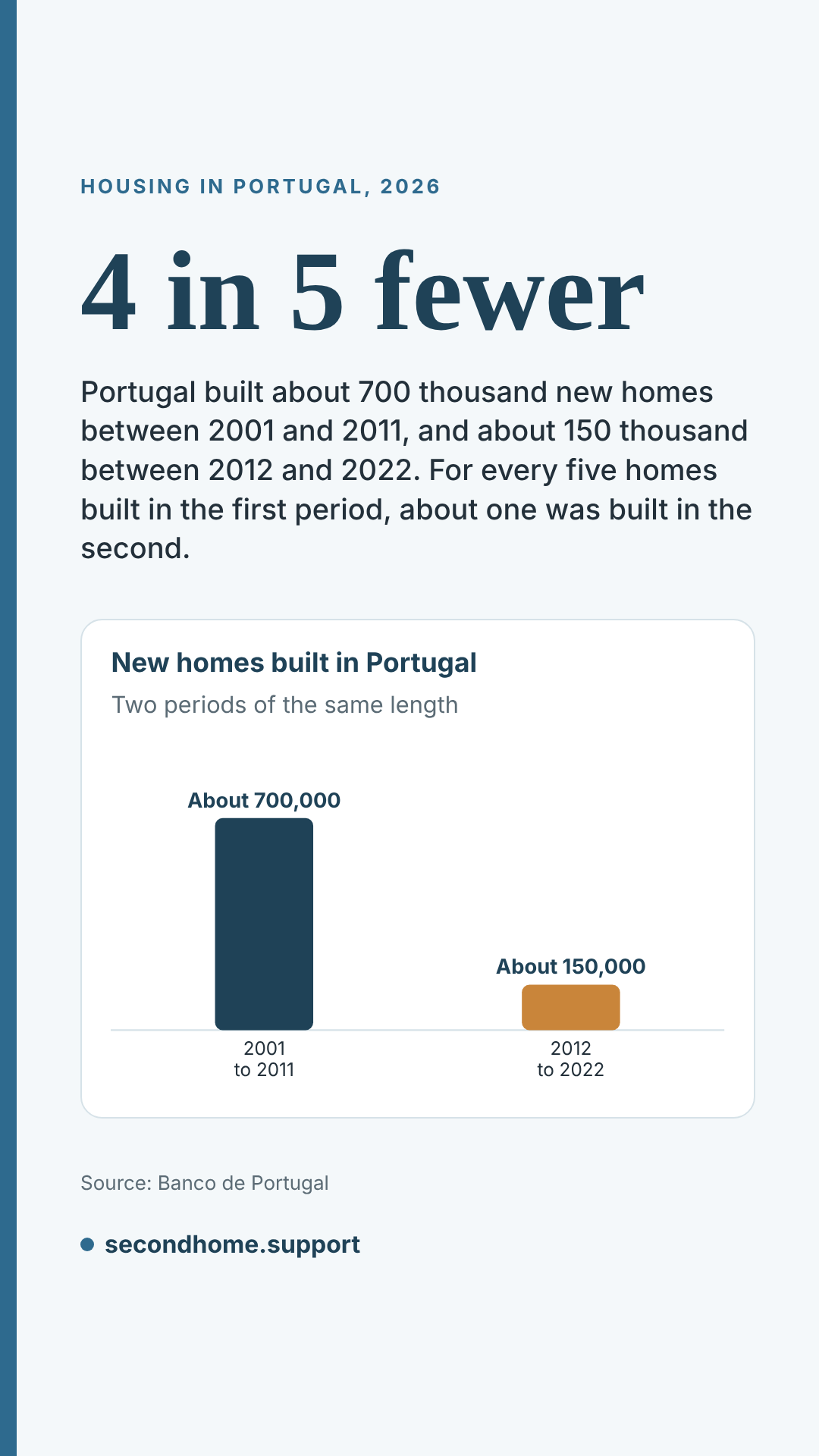
Portugal built about 700 thousand new homes between 2001 and 2011, and about 150 thousand between 2012 and 2022. For every five homes built in the first period, about one was built in the second.
New homes built in Portugal
Two periods of the same length
Source: Banco de PortugalData to: 2022 · Next update: None planned
secondhome.support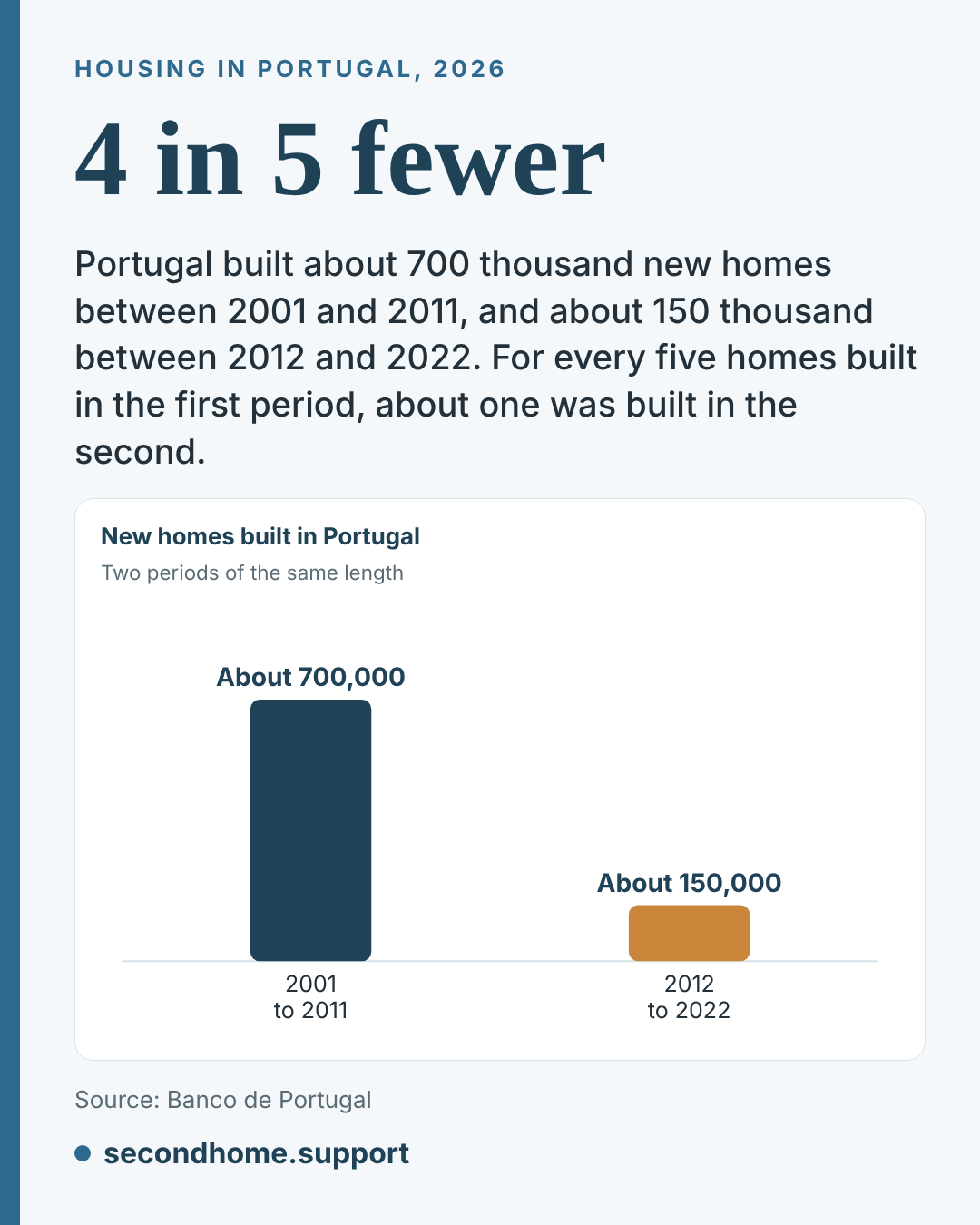
Few homes are being built
A study by Banco de Portugal's economists in 2024 found that demand drove most of the rise in prices since 2014, while building fell to about a fifth of what it had been.
In shortThe official estimates say prices are too high. They do not say prices are about to fall.
If you are buying a home in Portugal
What the figures mean when you are the one making the offer.
- Start from sold prices. Every price in this report is what homes sold for, or what banks valued them at. Look up what sold in your area before you look at what sellers are asking.
- The bank decides what it lends. It lends against its own valuation of the home. If the price you agree is higher, the difference comes out of your savings.
- A lower rate has not meant a lower payment. Rates fell and prices rose by enough to cancel it out. Work out the payment on the price in front of you, at today's rate.
- Cheaper areas are the ones rising fastest. The towns around Lisbon and Porto still cost less per m², and they have more than doubled in six years.
- You are bidding against people who live here. 95% of homes go to buyers living in Portugal, and more than half the money is borrowed.
- Nobody knows where prices go next. The European Commission and Banco de Portugal call prices overvalued. The International Monetary Fund does not expect a fall soon. Agree a price you can keep paying if prices stop rising.
If you are selling a home in Portugal
What the figures mean when you are the one setting the price.
- Your buyer most likely lives in Portugal. 95% do. The buyer from abroad is one sale in twenty.
- Your buyer most likely needs a bank. More than half the money in the market is borrowed. If the bank will not value the home at your price, that buyer cannot pay it.
- Your buyer is stretched. Pay rose 5.6% while prices rose 17.6%, and the loan payment already takes about 37% of average pay.
- Your area has its own number. Lisbon rose 52% in six years and Seixal rose 138%. The national figure says little about your street. Price from what sold near you.
- The rise is real, and it is already in the sold prices. A price that matches them can be backed with official figures. A price well above them has nothing behind it.
More on prices and rents by area
House prices by areaRents by areaWhat a home costs against a salaryProperty Atlas
How to read these figures
- Sold prices are medians. Half of homes sold for more and half for less. A median is not pulled up by a few very expensive homes, as an average is.
- Prices and rents are per m² of gross private area, the measure in the property record, which includes the walls. Listings often quote a smaller usable area, so a price per m² worked out from a listing will look higher.
- Local sold prices cover twelve months. The figure "to June 2026" is the median of sales from July 2025 to June 2026, so it trails today's market by several months.
- Rents are for new leases only. They say what it costs to rent a home now, and not what existing tenants pay.
- The pay measures differ. INE's €1,694 counts everything a worker is paid. The affordability series uses base pay from Pordata, which is lower, and carries it forward for 2025.
- Local prices are for mainland Portugal. Madeira and the Azores are in the national totals but not in the table of municipalities.
- Some figures reach us through news reports of official releases, and we say so where they appear: the bank lending figures, the Eurostat ratio of prices to income, the Algarve figures, the European Commission estimate of overvaluation, and the 2026 figures for prices, sales, pay, rates and lending.
How to cite this report
You are free to quote this report and reuse its figures with a link to this page. A suggested citation:
The underlying figures belong to their publishers. INE data is published under a Creative Commons Attribution 4.0 license. If you quote a single figure, please credit the original source named beside it.
Sources
- INE, House Price Index, fourth quarter of 2025 (published 23 March 2026)
- INE, Statistics on Rents of Housing at Local Level, first quarter of 2026 (published 26 June 2026)
- INE, Average gross monthly earnings per worker, December 2025 (published 13 February 2026)
- INE, Statistics on House Prices at Local Level, series to the second quarter of 2026, as held in this site's database
- Eurostat, House prices and rents went up in Q4 2025 (published 7 April 2026)
- Banco de Portugal, credit market report for 2025, as reported by Doutor Finanças
- Banco de Portugal, Financial Stability Report, May 2026, as reported by Jornal Económico (8 June 2026)
- INE figures on buyers by residence and place of birth, as reported by ECO (24 March 2026)
- INE figures for the Algarve, as reported by Barlavento (23 March 2026)
- Eurostat release of 9 November 2026 on house prices and income, as reported by The Portugal News (10 November 2026)
- European Commission, Housing in the European Union: Market Developments, Underlying Drivers, and Policies (October 2025), as reported by ECO News
- Banco de Portugal, Financial Stability Report, December 2019, special issue on methods for assessing house prices
- Banco de Portugal, Housing market in Portugal and Spain: fundamentals, overvaluation and shocks, Economic Studies (October 2024)
- International Monetary Fund, country report on Portugal, 2026
- Second Home Support, what a home costs against a salary: method and data
Look up your own area
The Property Atlas has sold prices, rents and bank valuations for every mainland municipality and for the parishes of Lisbon and Porto, updated each quarter.